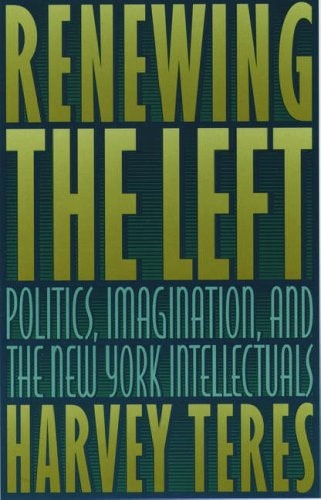
Renewing the Left: Politics, Imagination, and the New York Intellectuals
0
0
As an Amazon Associate and affiliate partner, Menrva Books earns from qualifying purchases. Learn more
Author Description
Never have the New York intellectuals received a full-scale, critical history. Now Harvey M. Teres brings to life this vibrant world from the 1930s to the present, drawing pointed lessons for progressive politics today. From Morris Dickstein to Norman Podhoretz, from Irving Howe to Jack Kerouac (whose protagonist in On the Road, Sal Paradise, flees "the tedious intellectualness" of the city), writers of all varieties have blossomed under or strained against New York's left-wing intellectual culture. Teres is the first to bring scrutiny to this hothouse of intellectual controversy.In Renewing the Left, Teres illuminates the work and legacy of New York's leading intellectuals, beginning with the founding of the influential Partisan Review before World War II. He first looks at William Phillips and Philip Rahv, the founders and chief editors of the Review, and shows how they laid the groundwork for a revitalized Marxist criticism, one that rejected the dogmatism of the Communist Party, stressing instead the freedom of the intellectual and the importance of literary criticism. In so doing, they transformed radical left-wing criticism into a new approach to literary texts and culture, appropriating much of the early criticism of T.S. Eliot. Teres carries the discussion from the late 1930s through the 1940s, as such critics as Rahv, Lionel Trilling, and F.W. Dupee absorbed modernism to renew the American left on both cultural and political fronts. From poet Wallace Stevens to critic Dwight Macdonald, New York intellectuals led an almost prescient critique of doctrinaire Marxism, stressing the essential role of the imagination. But Renewing the Left is no paean to radical champions of the past: Teres explores the inability of these critics to keep up with changes in popular culture. New York radical circles, moreover, failed to recognize postwar writing by women and African Americans, and they launched defensive attacks on the Beats and the counterculture of the 1960s.
Menrva's Summary
THE THESIS
How did the New York intellectuals shape the trajectory of American progressive politics and literary criticism from the 1930s to the present? Harvey M. Teres, an academic scholar, investigates the intellectual history of the New York circle centered around the Partisan Review. By analyzing the works of figures such as William Phillips, Philip Rahv, and Lionel Trilling, Teres argues that these thinkers successfully synthesized Marxist critique with modernist literary theory to challenge dogmatic political structures. The text examines how this group prioritized the role of the imagination in political discourse while simultaneously documenting their failures to adapt to the cultural shifts of the postwar era.
THE SCOPE MAP
What You Will Find
- A historical analysis of the Partisan Review and its foundational influence on 20th-century American thought.
- A critical examination of the shift from doctrinaire Marxism to a more nuanced, modernist-informed political criticism.
- Case studies on key intellectual figures including Irving Howe, Dwight Macdonald, and Norman Podhoretz.
- A critique of the movement's limitations regarding gender, race, and the emergence of the 1960s counterculture.
THE AUTHORITY PERSPECTIVE
Scholars and historians recognize this work as a comprehensive, critical history of a previously under-examined intellectual milieu. Readers frequently note the academic density of the prose, which serves as a foundational text for those studying the intersection of American radicalism and literary modernism.
Page Count:
336
Publication Date:
1996-04-18
Publisher:
Oxford University Press
ISBN-10:
0195078020
ISBN-13:
9780195078022
Politics
History
Biography
Authors American
Literary Criticism
Radicalism
Criticism history
New York
Imagination
Community Tags
Similar Books