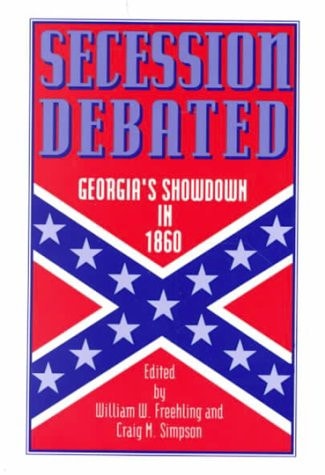
Secession Debated: Georgia's Showdown in 1860
0
0
As an Amazon Associate and affiliate partner, Menrva Books earns from qualifying purchases. Learn more
Author Description
The critical northern antebellum debate matched the rhetorical skills of Abraham Lincoln and Stephen A. Douglas in an historic argument over the future of slavery in a westward-expanding America. Two years later, an equally historic oratorical showdown between secessionists and Unionists in Georgia generated as much popular interest south of the Mason-Dixon line, and perhaps had an even more profound immediate effect on the future of the United States.With Abraham Lincoln's "Black Republican" triumph in the presidential election of 1860 came ardent secessionist sentiment in the South. But Unionists were equally zealous and while South Carolina--a bastion of Disunionism since 1832--seemed certain to secede; the other fourteen slave states were far from decided. In the deep South, the road to disunion depended much on the actions of Georgia, a veritable microcosm of the divided South and geographically in the middle of the Cotton South. If Georgia went for the Union, secessionist South Carolina could be isolated. So in November of 1860 all the eyes of Dixie turned to tiny Milledgeville, pre-war capital of Georgia, for a legislative confrontation that would help chart the course toward civil war.In Secession Debated, William W. Freehling and Craig M. Simpson have for the first time collected the seven surviving speeches and public letters of this greatest of southern debates over disunion, providing today's reader with a unique window into a moment of American crisis. Introducing the debate and debaters in compelling fashion, the editors help bring to life a sleepy Southern town suddenly alive with importance as a divided legislature met to decide the fate of Georgia, and by extension, that of the nation. We hear myriad voices, among them the energetic and self-righteous governor Joseph E. Brown who, while a slaveholder and secessionist, was somewhat suspect as a native North Georgian; Alexander H. Stephens, the eloquent Unionist whose "calm dispassionate approach" ult
Menrva's Summary
THE THESIS
This work investigates the pivotal legislative confrontation in Milledgeville, Georgia, in 1860, which served as a critical juncture in determining whether the state would secede or remain within the Union. Editors William W. Freehling and Craig M. Simpson, both established historians of the American South, curate a collection of primary source documents to analyze the rhetorical strategies employed by both secessionists and Unionists. By contextualizing these speeches and letters, the authors argue that Georgia's internal political struggle functioned as a microcosm for the broader national crisis that ultimately precipitated the American Civil War.
THE SCOPE MAP
What You Will Find
- A collection of seven surviving speeches and public letters from the 1860 Georgia legislative debate.
- Biographical profiles of key political figures, including Joseph E. Brown and Alexander H. Stephens.
- Historical analysis of the political climate in the deep South following the election of Abraham Lincoln.
- An examination of the strategic importance of Georgia's decision-making process in the context of the broader secessionist movement.
THE AUTHORITY PERSPECTIVE
Historians and scholars of the antebellum period frequently cite this collection as a vital primary source for understanding the internal political divisions within the South. Experts highlight the editors' ability to provide necessary context to these documents, making them accessible for both academic research and general historical inquiry.
Page Count:
192
Publication Date:
1992-10-29
Publisher:
Oxford University Press
ISBN-10:
0195079442
ISBN-13:
9780195079449
Biography
History
Civil War
Secession
Politics & Government
American History
Georgia history
Community Tags
Similar Books