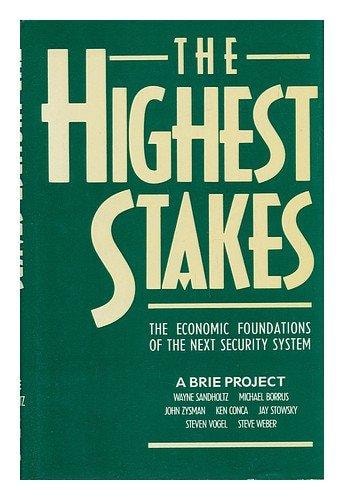
The Highest Stakes: The Economic Foundations of the Next Security System
0
0
As an Amazon Associate and affiliate partner, Menrva Books earns from qualifying purchases. Learn more
Author Description
Will markets, investment, and technology--rather than tanks and missiles--be the key elements in the new world order? When politics catches up with the global whirlwind of shifting economic capabilities, the international system will look very different than how it does today. This book explores how the momentous dislocations of economic power in the world--the might of Asia, the unification of Europe, the relative decline of the United States--will reshape global security issues. The authors explain power and interests are changing and how the loss of industrial and technological leadership is undermining the exercise of American power. They demonstrate how these changes may presage an entirely new era that would reconceive the very nature of security, redefine the international power game, and resituate its players. This volume first sets the stakes--drawing the links between economic capacities and security. Then the players are covered, detailing the relative positions of Asia, Europe, and United States. The book concludes with a warning that the emerging distribution of economic capabilities does not insure a natural extension of the present international security arrangement. At least two other directions are possible, each implying not only new security concerns at home, but a transformation in the international security system as a whole.
Menrva's Summary
THE THESIS
This volume investigates whether economic capabilities, technological advancement, and market dynamics have replaced traditional military force as the primary determinants of global security in the post-Cold War era. The authors, a collective of scholars from the Berkeley Roundtable on the International Economy, utilize a framework that links industrial competitiveness directly to national power. They argue that the shifting economic landscape—characterized by the rise of Asia, European integration, and the relative decline of American industrial leadership—necessitates a fundamental reconceptualization of how international security is defined and maintained.
THE SCOPE MAP
What You Will Find
- Analysis of the correlation between industrial capacity and national security interests.
- Comparative assessment of economic power shifts in Asia, Europe, and the United States.
- Examination of how technological leadership impacts the exercise of global influence.
- Projections regarding the potential transformation of the international security system.
THE AUTHORITY PERSPECTIVE
Experts recognize this work as a significant contribution to the study of political economy and its intersection with security policy. Readers frequently note the analytical density of the text, which provides a rigorous framework for understanding the structural changes in global power dynamics.
Page Count:
272
Publication Date:
1992-08-13
Publisher:
Oxford University Press
ISBN-10:
0195070356
ISBN-13:
9780195070354
Economics
International relations
Geopolitics
United States
National security
Community Tags
Similar Books