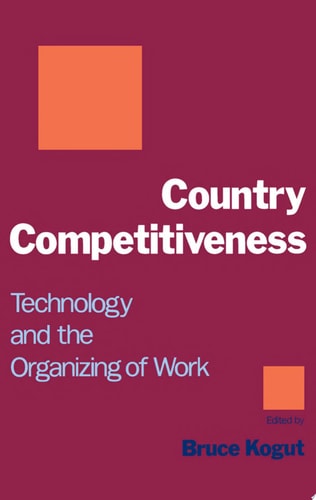
Country Competitiveness: Technology and the Organizing of Work
0
0
As an Amazon Associate and affiliate partner, Menrva Books earns from qualifying purchases. Learn more
Author Description
With the expansion of global competition through international trade agreements and heightened rivalry between firms in the domestic market, it is easy to understand why a firm would seek to compete by lowering the wages paid to labor. Yet, this strategy is troubled not only by the efforts of other firms pursuing cheaper labor costs, but also by the failure to adopt better ways of organizing work. New products are copied within a short time after introduction. What is difficult to imitate is the organizing of work--as applied to the factory floor, to the corporation, and to relations among firms and other institutions. This book explores detailed case studies of individual firms, country comparisons, and historical patterns of diffusion. The authors emphasize that the speed by which a firm adopts and integrates new technologies and ways of organizing must be understood in the context of the strength of the regional and national network of firms and institutions. The chapters in the book are written by world-renowned scholars--including Giovanni Dosi, Horst Kern, Michael Schumann, and Eleanor D. Westner--and represent major schools of thought from Germany, France, the U.S., Japan, and the United Kingdom. The studies are international in nature and include in-depth analyses of software systems, automobile manufacturing (e.g. the Toyota Production System), and the machine tool industry.
Menrva's Summary
THE THESIS
This book investigates how the organizational structure of work, rather than mere cost-cutting, serves as the primary driver of national and firm-level competitiveness in a globalized market. Bruce M. Kogut and a team of international scholars analyze how the integration of new technologies is mediated by regional and national institutional frameworks. By examining the diffusion of organizational practices across different countries, the text argues that competitive advantage is rooted in the social and institutional networks that facilitate or hinder innovation.
THE SCOPE MAP
What You Will Find
- Comparative analysis of industrial systems in Germany, France, the U.S., Japan, and the United Kingdom.
- Detailed case studies of the Toyota Production System and the machine tool industry.
- Examination of the relationship between software systems and factory floor management.
- Theoretical frameworks regarding the diffusion of organizational innovation and institutional strength.
THE AUTHORITY PERSPECTIVE
Experts recognize this collection as a significant contribution to the study of comparative institutional economics and industrial organization. Readers frequently note the academic density of the prose, which provides a rigorous, multi-disciplinary perspective on the intersection of technology and labor management.
Page Count:
280
Publication Date:
1993-08-05
Publisher:
Oxford University Press
ISBN-10:
0195072774
ISBN-13:
9780195072778
Business
Economics
Management
Globalization
Case studies
Technology
Competition
Community Tags
Similar Books