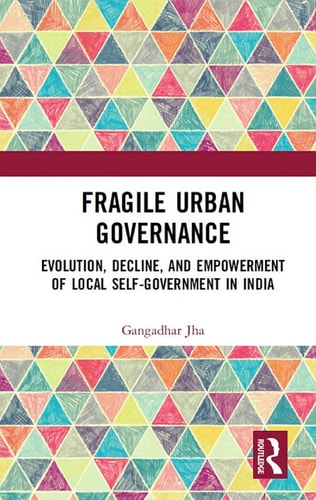
Fragile Urban Governance
0
0
As an Amazon Associate and affiliate partner, Menrva Books earns from qualifying purchases. Learn more
Author Description
Urbanization is giving rise to a vibrant and volatile urban India. The urban local self-government (ULSG) is struggling to provide efficient, effective, inclusive and responsive urban services. Most ULSGs are too fragile to perform the mandated functions for enhancing the quality of life and making cities and towns livable. The book traces evolution of ULSGs, its decline after Independence, and steps taken to strengthen them, especially through the big-bang decentralization initiative of 1992 for their empowerment, by enacting the 74th Constitution Amendment Act (74th CAA). Analyzing facets of the decentralization initiative, views of two review Commissions, policy responses to it and processes for implementation of constitutional provisions, it alludes to conspicuous gaps at three levels such as (i) gaps and deficiencies in the 74th CAA (ii) gaps in the post-74th CAA municipal Acts that were required to conform to the constitutional provisions, and (iii) gaps due to half-hearted implementation of even the mandatory constitutional provisions. Empowerment and strengthening of ULSG being in the nature of an imperative, it explores plausible options within the constitutional autonomy of states. Empowerment denotes authority, power and clarity in municipal functional and fiscal domain. Therefore it also specifies experiential based rational framework and a strategy for strengthening ULSGs that must look beyond the existing predilection for mere training. It fills an existing void in ULSG literature on the subject. Please note: Taylor & Francis does not sell or distribute the Hardback in India, Pakistan, Nepal, Bhutan, Bangladesh and Sri Lanka
Menrva's Summary
THE THESIS
The core problem this book investigates is the inherent fragility of urban local self-governments (ULSG) in India, which hinders their ability to provide essential urban services and improve the quality of life. The book traces the historical evolution and subsequent decline of ULSGs, particularly after India's independence, and examines the decentralization efforts initiated by the 74th Constitution Amendment Act of 1992 aimed at their empowerment. It critically analyzes the shortcomings within the Act itself, the post-amendment municipal acts, and the inconsistent implementation of these provisions, highlighting significant gaps at multiple levels. The author proposes a rational framework and strategy for strengthening ULSGs, focusing on enhancing their functional and fiscal autonomy beyond mere training, exploring plausible options within the states' constitutional powers.
THE SCOPE MAP
- The historical evolution and post-independence decline of Urban Local Self-Governments (ULSG) in India.
- An analysis of the 74th Constitution Amendment Act (1992) as a decentralization initiative.
- Examination of the views of two review commissions on decentralization.
- Assessment of policy responses and implementation processes related to the 74th CAA.
- Identification of gaps in the 74th CAA, subsequent municipal acts, and their implementation.
- A proposed framework and strategy for strengthening ULSGs, focusing on functional and fiscal empowerment.
- Exploration of options for strengthening ULSGs within the constitutional autonomy of states.
THE AUTHORITY PERSPECTIVE
This book critically examines the structural weaknesses and implementation challenges faced by India's urban local self-governments. It delves into the historical context and the impact of the 74th Constitution Amendment Act, identifying deficiencies at the legislative and implementation levels. The work aims to fill a void in existing literature by proposing practical strategies for strengthening these institutions. The analysis suggests a need for a more robust approach to urban governance that moves beyond superficial training to address fundamental issues of authority and fiscal autonomy.
Page Count:
384
Publication Date:
2018-06-13
Publisher:
Taylor & Francis
ISBN-10:
0429799047
ISBN-13:
9780429799044
History
Politics
Non-Fiction
Public Administration
Indian Politics
Urban Studies
Community Tags
Similar Books