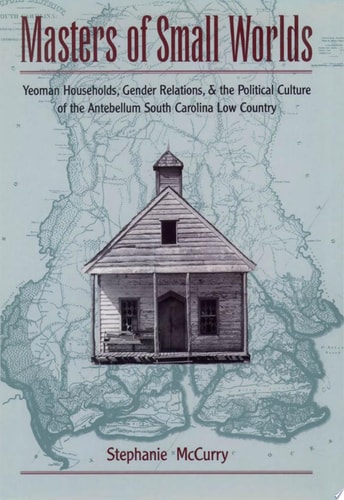
Masters of Small Worlds: Yeoman Households, Gender Relations, and the Political Culture of the Antebellum South Carolina Low Country
0
0
As an Amazon Associate and affiliate partner, Menrva Books earns from qualifying purchases. Learn more
Author Description
In this innovative study of the South Carolina Low Country, author Stephanie McCurry explores the place of the yeomanry in plantation society--the complex web of domestic and public relations within which they were enmeshed, and the contradictory politics of slave society by which that class of small farmers extracted the privileges of masterhood from the region's powerful planters. Insisting on the centrality of women as historical actors and gender as a category of analysis, this work shows how the fateful political choices made by the low-country yeomanry were rooted in the politics of the household, particularly in the customary relations of power male heads of independent households assumed over their dependents, whether slaves or free women and children. Such masterly prerogatives, practiced in the domestic sphere and redeemed in the public, explain the yeomanry's deep commitment to slavery and, ultimately, their ardent embrace of secession.By placing the yeomanry in the center of the drama, McCurry offers a significant reinterpretation of this volatile society on the road to Civil War. Through careful and creative use of a wide variety of archival sources, she brings vividly to life the small worlds of yeoman households, and the larger world of the South Carolina Low Country, the plantation South, and nineteenth-century America.
Menrva's Summary
THE THESIS
This study investigates how the yeomanry of the South Carolina Low Country reconciled their status as small farmers with the hierarchical demands of a slave-holding plantation society. Stephanie McCurry, a historian specializing in the American South, utilizes archival records and household data to argue that the political identity of these men was fundamentally shaped by their domestic authority. By examining the intersection of gender, class, and race, the author demonstrates that the yeomanry's commitment to slavery and secession was rooted in their desire to maintain patriarchal control over their own households.
THE SCOPE MAP
What You Will Find
- Analysis of the social and political structure of the antebellum South Carolina Low Country.
- Examination of the domestic power dynamics between male heads of households and their dependents, including slaves, women, and children.
- Extensive use of primary source archival materials, including court records, census data, and personal correspondence.
- A reinterpretation of the yeomanry's role in the political trajectory leading to the American Civil War.
THE AUTHORITY PERSPECTIVE
Historians frequently cite this work as a foundational text for understanding the intersection of gender and political power in the nineteenth-century South. Experts highlight the author's rigorous methodology and her ability to integrate domestic history into the broader political narrative of the plantation era.
Page Count:
320
Publication Date:
1995-05-11
Publisher:
Oxford University Press
ISBN-10:
0195072367
ISBN-13:
9780195072365
Politics
History
Political History
South carolina history
United States
Social Conditions
Social History
Categories
Social Classes
Kindle eBooks
Gender Studies
Americas
Kindle Store
American History
Sex Role
Community Tags
Similar Books