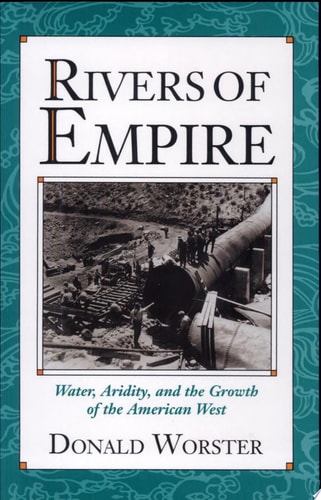
Rivers of Empire: Water, Aridity, and the Growth of the American West
0
0
As an Amazon Associate and affiliate partner, Menrva Books earns from qualifying purchases. Learn more
Author Description
When Henry David Thoreau went for his daily walk, he would consult his instincts on which direction to follow. More often than not his inner compass pointed west or southwest. "The future lies that way to me," he explained, "and the earth seems more unexhausted and richer on that side." In his own imaginative way, Thoreau was imitating the countless young pioneers, prospectors, and entrepreneurs who were zealously following Horace Greeley's famous advice to "go west." Yet while the epic chapter in American history opened by these adventurous men and women is filled with stories of frontier hardship, we rarely think of one of their greatest problems--the lack of water resources. And the same difficulty that made life so troublesome for early settlers remains one of the most pressing concerns in the western states of the late-twentieth century.The American West, blessed with an abundance of earth and sky but cursed with a scarcity of life's most fundamental need, has long dreamed of harnessing all its rivers to produce unlimited wealth and power. In Rivers of Empire, award-winning historian Donald Worster tells the story of this dream and its outcome. He shows how, beginning in the mid-nineteenth century, Mormons were the first attempting to make that dream a reality, damming and diverting rivers to irrigate their land. He follows this intriguing history through the 1930s, when the federal government built hundreds of dams on every major western river, thereby laying the foundation for the cities and farms, money and power of today's West. Yet while these cities have become paradigms of modern American urban centers, and the farms successful high-tech enterprises, Worster reminds us that the costs have been extremely high. Along with the wealth has come massive ecological damage, a redistribution of power to bureaucratic and economic elites, and a class conflict still on the upswing. As a result, the future of this "hydraulic West" is increasingly uncertain, as water
Menrva's Summary
THE THESIS
How did the scarcity of water in the American West dictate the development of its social, political, and economic structures? Donald Worster, a prominent environmental historian, examines the transformation of the arid western landscape into a managed hydraulic empire. He argues that the necessity of controlling water resources led to the rise of centralized bureaucratic power, significant ecological degradation, and the consolidation of wealth among economic elites.
THE SCOPE MAP
What You Will Find
- Historical analysis of water management from the mid-nineteenth century to the late twentieth century.
- Examination of the transition from early Mormon irrigation efforts to massive federal dam projects.
- Evaluation of the social and class-based consequences of large-scale hydraulic engineering.
- Critique of the environmental impact resulting from the industrialization of western river systems.
THE AUTHORITY PERSPECTIVE
Historians and environmental scholars frequently cite this work as a foundational text for understanding the political economy of the American West. Readers often note the dense, analytical nature of the prose, which provides a rigorous critique of how resource management shapes regional power dynamics.
Page Count:
416
Publication Date:
1992-06-18
Publisher:
Oxford University Press
ISBN-10:
0195078063
ISBN-13:
9780195078060
Politics
History
United States
Rivers
West Us
Geography
American West
Ecology
Environmental History
Community Tags
Similar Books