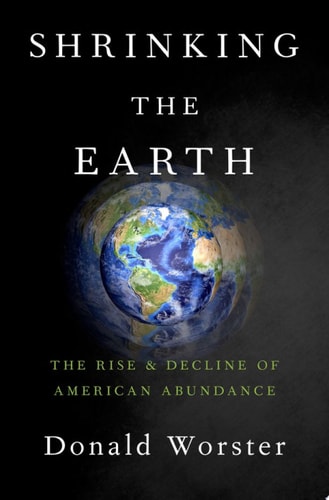
Shrinking the Earth: The Rise and Decline of Natural Abundance
0
0
As an Amazon Associate and affiliate partner, Menrva Books earns from qualifying purchases. Learn more
Author Description
The discovery of the Americas around 1500 AD was an extraordinary watershed in human experience. It gave rise to the modern period of human ecology, a phenomenon global in scope that set in motion profound changes in almost every society on earth. This new period, which saw the depletion of the lands of the New World, proved tragic for some, triumphant for others, and powerfully affecting for all.In this work, acclaimed environmental historian Donald Worster takes a global view in his examination of the ways in which complex issues of worldwide abundance and scarcity have shaped American society and behavior over three centuries. Looking at the limits nature imposes on human ambitions, he questions whether America today is in the midst of a shift from a culture of abundance to a culture of limits--and whether American consumption has become reliant on the global South. Worster engages with key political, economic, and environmental thinkers while presenting his own interpretation of the role of capitalism and government in issues of wealth, abundance, and scarcity. Acknowledging the earth's agency throughout human history, Shrinking the Earth offers a compelling explanation of how we have arrived where we are and a hopeful way forward on a planet that is no longer as large as it once was.
Menrva's Summary
THE THESIS
How has the transition from a perceived era of global abundance to one of environmental limits shaped the trajectory of American society and its relationship with the rest of the world? Donald Worster, a prominent environmental historian, utilizes a historical framework to analyze the intersection of capitalism, government policy, and ecological constraints. By examining the exploitation of natural resources following the discovery of the Americas, he argues that modern human ecology is defined by a shift from expansionist consumption to a precarious reliance on global resources. The work synthesizes political and economic theory to evaluate the sustainability of current American consumption patterns.
THE SCOPE MAP
What You Will Find
- A historical analysis of resource depletion from 1500 AD to the present.
- An examination of the role of capitalism in driving global scarcity.
- A critique of the relationship between the global North and the global South regarding resource extraction.
- Interpretations of key political and environmental thinkers.
Scope Limits
- The text does not provide a technical manual for specific conservation technologies.
- It does not offer a localized study of specific ecosystems, focusing instead on broad, global historical trends.
THE AUTHORITY PERSPECTIVE
Scholars and critics frequently note the academic rigor and historical depth Worster brings to the study of environmental ethics. Experts highlight this as a significant contribution to the field of environmental history that challenges readers to reconsider the foundations of modern economic growth.
Page Count:
279
Publication Date:
2016-01-01
Publisher:
Oxford University Press
ISBN-10:
0190265035
ISBN-13:
9780190265038
Economics
History
Capitalism
American History
Sustainability
Environmental History
Ecology
Community Tags
Similar Books