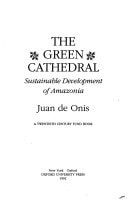
The Green Cathedral: Sustainable Development of Amazonia
Author Description
When the first Iberian adventurers discovered the Amazon and the native Indian and tribal peoples living along its banks, they believed they had stumbled upon what one traveler later called "the unfinished last page of Genesis." Legends sprang up of El Dorado, the gilded man, and a golden city hidden along the river which would bring limitless wealth to its discoverer. Today the tropical rain forests of the Amazon have no less a hold on the world's imagination--environmentalists plead for the last great wilderness, a fragile Eden whose fate is intimately linked with the fate of the earth, while landless peasants and the garimpeiros, or wildcat miners, stream to what they perceive as the last frontier, rich in untapped resources and possibilities. The tension between the needs of the delicate and irreplaceable ecosystem and the no-less-compelling needs of the population seemed inevitable, and perhaps insolvable.In The Green Cathedral, Juan de Onis offers a set of proposals for the economic and ecological survival of this vital region, arguing that it is not possible to save the trees of Amazonia without also saving its people. A former foreign correspondent for the New York Times who has known Amazonia since the early sixties, de Onis undertook an intensive two year study of the region in 1988, travelling over 36,000 kilometers by land, water and air to interview the homesteaders, garimpeiros, cattle ranchers, bureaucrats, peasant organizers, Indians, and activists who together will decide the future of the vast forests. Avoiding the doomsday tone of many experts, de Onis not only draws a vivid portrait of the greenest part of the earth and the rawness of life on the frontier, but also argues that Amazonia is not yet ecologically ruined nor economically crippled. Indeed, he uncovers heartening evidence that the peoples and governments of Amazonia are learning from the past, finding ways of preserving and profiting from their environment. For instance, the farmers and
Menrva's Summary
THE THESIS
Can the Amazon basin achieve a balance between ecological preservation and the economic survival of its inhabitants? Juan de Onis, a veteran foreign correspondent, utilizes his extensive field research to challenge the binary narrative of environmental collapse versus unchecked exploitation. He argues that the future of the region depends on integrated strategies that prioritize the welfare of local populations alongside the protection of the rainforest ecosystem.
THE SCOPE MAP
What You Will Find
- Analysis of the socio-economic pressures driving landless peasants and miners into the Amazon frontier.
- Evaluation of sustainable development models that incorporate local agricultural and economic needs.
- Primary source interviews with homesteaders, cattle ranchers, indigenous leaders, and government bureaucrats.
- A comprehensive assessment of regional environmental health based on 36,000 kilometers of travel and two years of field study.
THE AUTHORITY PERSPECTIVE
Experts recognize this work as a significant contribution to the discourse on Amazonian development, noting its departure from alarmist rhetoric in favor of practical, human-centered solutions. Readers frequently highlight the author's journalistic rigor and his ability to synthesize complex regional dynamics into a coherent policy framework.
Page Count:
304
Publication Date:
1992-06-02
Publisher:
Oxford University Press
ISBN-10:
0195074602
ISBN-13:
9780195074604
Ecology
Sociology
Environment
Latin America
Nature
Community Tags
Similar Books