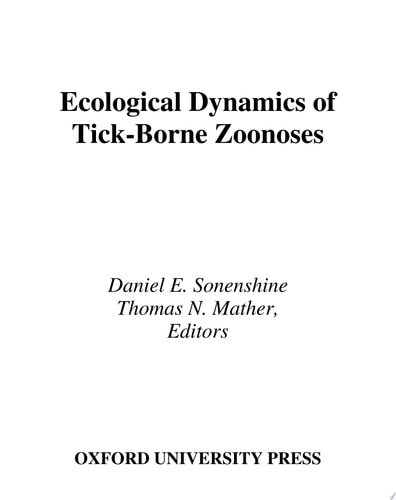
Ecological Dynamics of Tick-Borne Zoonoses
0
0
As an Amazon Associate and affiliate partner, Menrva Books earns from qualifying purchases. Learn more
Author Description
The ecological relationships found to exist between tick vectors and pathogens in their zootic cycle can profoundly influence patterns of transmission and disease for humans and domestic animals. This book examines the ecological parameters affecting the conservation and regulation of tick-borne zoonoses as well as the geographic and seasonal distributions of those infections. Written by an eminent authority on the subject, the book will be sought after by students and researchers in ecology, invertebrate zoology, parasitology, entomology, public health, and epidemiology.
Menrva's Summary
THE THESIS
This book investigates the complex ecological interactions between tick vectors and pathogens that dictate the transmission patterns of zoonotic diseases in human and animal populations. The authors, Daniel E. Sonenshine and Thomas N. Mather, utilize their extensive expertise in acarology and parasitology to synthesize current research on how environmental variables influence the life cycles of ticks. By examining the intersection of host availability, climate, and pathogen survival, the text provides a comprehensive framework for understanding the persistence and spread of tick-borne infections.
THE SCOPE MAP
What You Will Find
- Analysis of ecological parameters affecting the conservation and regulation of tick-borne zoonoses.
- Examination of geographic and seasonal distribution patterns of tick-borne pathogens.
- Evaluation of the zootic cycles involving tick vectors and their hosts.
- Discussion of public health implications regarding disease transmission dynamics.
THE AUTHORITY PERSPECTIVE
Experts recognize this work as a foundational text for researchers and students in the fields of entomology and epidemiology. Readers frequently note the technical density of the prose, which serves as a rigorous resource for those studying the environmental drivers of infectious disease.
Page Count:
464
Publication Date:
1994-10-20
Publisher:
Oxford University Press
ISBN-10:
0195073134
ISBN-13:
9780195073133
Science
Zoonoses
Ecology
Public Health
Entomology
Parasitology
Epidemiology
Biology
Community Tags
Similar Books