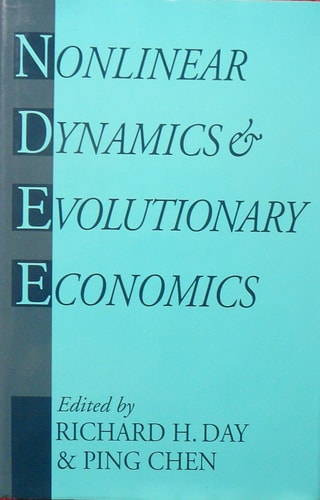
Nonlinear Dynamics and Evolutionary Economics
0
0
As an Amazon Associate and affiliate partner, Menrva Books earns from qualifying purchases. Learn more
Author Description
Advances in physics, computers, and mathematics have made it possible to illustrate an astonishing array of potential behavior that can occur when nonlinear interactions are present. As Prigogine explains from a physicist's perspective, the fundamental role of instability and bounded rationality provide more precise understanding for evolution and changes. This volume considers these developments from various fields in the context of economic science. The work starts with a general non-mathematical discussion, introducing the major themes--nonlinearity, dynamical systems, and evolution in economic processes. The work continues with nonlinear analysis of macroeconomic growth and fluctuations. It describes analyses of economic adaptation, learning, and self-organization. The volume also scrutinizes a specific market--equities using nonlinear analysis, controlled experiments, and statistical inference when nonlinearity plays an essential role in data generation. The volume closes with an historical reflection by Richard Goodwin and a roundtable discussion on basic issues and new challenges in nonlinear economic dynamics.
Menrva's Summary
THE THESIS
This volume investigates how nonlinear dynamics, instability, and bounded rationality can be integrated into economic theory to better explain evolutionary processes and market fluctuations. The authors, Ping Chen and Richard H. Day, synthesize insights from physics, mathematics, and computer science to challenge traditional linear economic models. By applying these interdisciplinary frameworks, the text argues that economic systems are inherently complex and adaptive rather than static or equilibrium-driven.
THE SCOPE MAP
What You Will Find
- Theoretical foundations of nonlinearity, dynamical systems, and evolutionary processes in economic contexts.
- Nonlinear analysis applied to macroeconomic growth, fluctuations, and market behavior.
- Methodologies including controlled experiments, statistical inference, and computational modeling.
- Historical perspectives and roundtable discussions on the future challenges of nonlinear economic dynamics.
THE AUTHORITY PERSPECTIVE
Experts recognize this volume as a significant contribution to the intersection of complexity science and economic theory. Readers frequently note the academic density of the prose, which requires a foundational understanding of both economic principles and mathematical modeling to fully grasp the arguments presented.
Page Count:
352
Publication Date:
1993-09-16
Publisher:
Oxford University Press
ISBN-10:
0195078594
ISBN-13:
9780195078596
Economics
Mathematics
Economics Mathematical
Evolutionary Economics
Physics
Chaotic behavior in systems
Nonlinear Dynamics
Macroeconomics
Community Tags
Similar Books