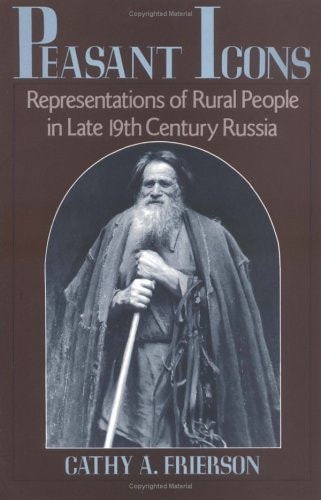
Peasant Icons: Representations of Rural People in Late Nineteenth-Century Russia
0
0
As an Amazon Associate and affiliate partner, Menrva Books earns from qualifying purchases. Learn more
Author Description
In the thirty years after Russian peasants were emancipated in 1861, they became a major focus of Russian intellectual life. This text is the first to examine the revealing images of the peasant created by Russian writers, scholars, journalists, and government officials during that period, as the identity and fate of the Russian peasant became an integral component in the future of Russia envisioned by liberal reformers and conservatives alike. Frierson examines the persisting stereotypes created by Tolstoy, Dostoevsky and other intellectuals seeking to understand village life, from the likable narod, the simple folk, to the exploitative kulak, the village strongman.
Menrva's Summary
THE THESIS
This book investigates how Russian intellectuals constructed and utilized representations of the peasantry to define national identity and political reform in the decades following the 1861 Emancipation. Cathy A. Frierson, a scholar of Russian history, analyzes a diverse array of primary sources including literature, journalism, and government reports. She argues that these depictions were not objective observations but rather ideological tools used by both liberals and conservatives to project their own visions for the future of the Russian state.
THE SCOPE MAP
What You Will Find
- Analysis of the post-Emancipation period from 1861 to the late nineteenth century.
- Examination of literary archetypes including the 'narod' and the 'kulak' as portrayed by figures like Tolstoy and Dostoevsky.
- Evaluation of how government officials and journalists shaped public perception of rural life.
- Exploration of the intersection between intellectual discourse and the socio-political fate of the peasantry.
THE AUTHORITY PERSPECTIVE
Historians and scholars of Slavic studies identify this work as a significant contribution to the understanding of Russian social thought and the cultural construction of the peasantry. Readers frequently note the academic rigor of the research and the clarity with which the author navigates complex intellectual debates.
Page Count:
272
Publication Date:
1993-02-11
Publisher:
Oxford University Press
ISBN-10:
0195072944
ISBN-13:
9780195072945
History
In literature
Russian History
Intellectual History
Sociology
Community Tags
Similar Books