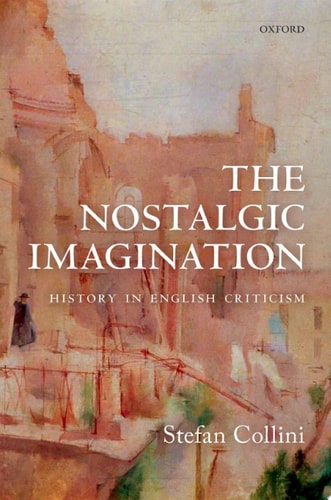
The Nostalgic Imagination: History in English Criticism
0
0
As an Amazon Associate and affiliate partner, Menrva Books earns from qualifying purchases. Learn more
Author Description
This unusual book explores the historical assumptions at work in the style of literary criticism that came to dominate English studies in the twentieth century. Stefan Collini shows how the work of critics renowned for their close attention to 'the words on the page' was in practice bound up with claims about the nature and direction of historical change, the interpretation of the national past, and the scholarship of earlier historians. Among the major figures examined in detail are T.S. Eliot, F.R. Leavis, William Empson, and Raymond Williams, while there are also original discussions of such figures as Basil Willey, L.C. Knights, Q.D. Leavis, and Richard Hoggart. The Nostalgic Imagination argues that in the period between Eliot's The Sacred Wood and Williams's The Long Revolution, the writings of such critics came to occupy the cultural space left by academic history's retreat into specialized, archive-bound monographs. Their work challenged the assumptions of the Whig interpretation of English history, and entailed a revision of the traditional relations between 'literary history' and 'general history'. Combining close textual analysis with wide-ranging intellectual history, this volume both revises the standard story of the history of literary criticism and illuminates a central feature of the cultural history of twentieth-century Britain.
Menrva's Summary
THE THESIS
This book investigates how twentieth-century English literary criticism functioned as a surrogate for historical inquiry by embedding specific assumptions about national identity and change within its analytical frameworks. Stefan Collini, a scholar of intellectual history, examines the intersection of literary theory and historiography. He argues that critics often bypassed academic history to construct their own narratives of the past, thereby influencing the cultural understanding of English development during the twentieth century.
THE SCOPE MAP
What You Will Find
- Analysis of major critics including T.S. Eliot, F.R. Leavis, William Empson, and Raymond Williams
- Examination of the shift from literary criticism to cultural history
- Critique of the Whig interpretation of English history
- Comparative study of literary history versus general history
Scope Limits
- Does not provide a comprehensive history of all English literary criticism
- Focuses primarily on the twentieth-century British context
THE AUTHORITY PERSPECTIVE
Scholars recognize this work as a significant contribution to the history of ideas, noting its ability to bridge the gap between literary studies and historical methodology. Readers frequently highlight the clarity of Collini's prose and the depth of his archival research into the intellectual climate of the era.
Page Count:
256
Publication Date:
2019-01-01
Publisher:
OUP Oxford
ISBN-10:
0192520717
ISBN-13:
9780192520715
History
British History
English literature
Literary Criticism
In literature
European History
History of Ideas
Intellectual History
Community Tags
Similar Books