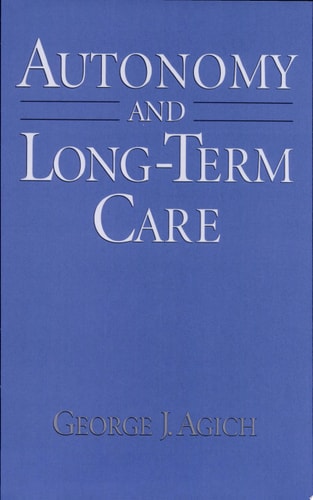
Autonomy and Long-Term Care
0
0
As an Amazon Associate and affiliate partner, Menrva Books earns from qualifying purchases. Learn more
Author Description
The realities and misconceptions of long-term care and the challenges it presents for the ethics of autonomy are analyzed in this perceptive work. While defending the concept of autonomy, the author argues that the standard view of autonomy as non-interference and independence has only a limited applicability for long-term care. He explains that autonomy should be understood as a comprehensiveness that defines the overall course of a person's life rather than as a way of responding to an isolated situation. Agich distinguishes actual and ideal autonomy and argues that actual autonomy is better revealed in the everyday experiences of long-term care than in dramatic, conflict-ridden paradigm situations such as decisions to institutionalize, to initiate aggressive treatments, or to withhold or to withdraw life-sustaining treatments. Through a phenomenological analysis of long-term care, he develops an ethical framework for it by showing how autonomy is actually manifest in certain structural features of the social world of long-term care. Throughout this timely work, the rich sociological and anthropological literature on aging and long-term care is referenced and the practical ethical questions of promoting and enhancing the exercise of autonomy are addressed
Menrva's Summary
THE THESIS
This work investigates the core question of how the concept of autonomy can be meaningfully applied to the complex, everyday realities of long-term care. George J. Agich, a scholar in bioethics, challenges the traditional view of autonomy as mere non-interference. He argues that autonomy in long-term care should be understood as a life-long process of self-definition rather than an isolated decision-making event. By utilizing a phenomenological approach, he provides a framework that reconciles individual agency with the structural constraints of institutionalized care environments.
THE SCOPE MAP
What You Will Find
- A phenomenological analysis of the social world within long-term care facilities.
- A distinction between actual and ideal autonomy in the context of aging.
- Integration of sociological and anthropological research regarding the aging process.
- Practical ethical strategies for promoting and enhancing patient autonomy in daily life.
THE AUTHORITY PERSPECTIVE
Experts in bioethics and gerontology recognize this text as a foundational contribution to the discourse on patient agency in chronic care settings. Readers frequently note the academic density of the prose, which is balanced by the author's rigorous application of philosophical theory to practical clinical scenarios.
Page Count:
197
Publication Date:
1993-01-15
Publisher:
Oxford University Press
ISBN-10:
0195074955
ISBN-13:
9780195074956
Philosophy
Older people
Sociology
Aging
Ethics
Medical Ethics
Gerontology
Community Tags
Similar Books