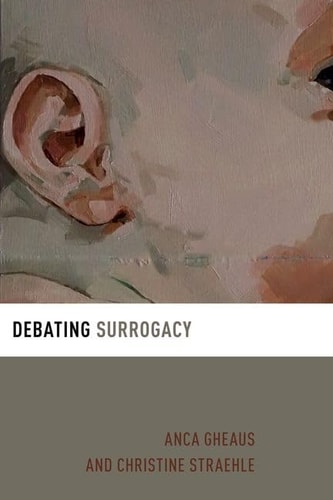
Debating Surrogacy
0
0
As an Amazon Associate and affiliate partner, Menrva Books earns from qualifying purchases. Learn more
Author Description
Surrogacy is the commissioning of a woman to gestate and give birth to a child for another would-be parent. The practice raises several ethical questions, such as the commodification of the surrogate and of the baby, and the exploitation of the surrogate, issues which have been extensively debated. This book offers a fresh take on surrogacy, by concentrating on questions which bear on its justifiability: Is providing gestational services a permissible way of employing a woman's body? Indeed, is it a legitimate form of work? Are the children born out of surrogacy in any way wronged by surrogacy agreements?In the first part of the book, Christine Straehle proposes an account of surrogacy work as legitimate work for women, as a way to realize certain goals in women's lives through the fruit of their labour. She defends a right to become a surrogate as necessary to protect women's autonomy. Anca Gheaus criticises surrogacy by arguing that it always wrongs children--whether or not it also harms them--by disrespecting them; therefore, gestational services are impermissible. In the second part, Straehle responds to Gheaus, questioning that children are wronged by the practice of surrogacy. Instead, she defends an intentional model of parental rights, which indicates that having a child through surrogacy should count as a ground to assign parental rights. In her response, Gheaus objects that Straehle's view fails to properly account for the interests of either surrogates or children. However, she accepts that women may gestate without the intention to have custody over the newborn, and is therefore open to some kind of post-surrogacy practice that would radically depart, in the allocation of legal parenthood, from any historical or currently proposed form of surrogacy.
Menrva's Summary
THE THESIS
This book investigates the moral permissibility of surrogacy by examining whether gestational services constitute legitimate labor and whether the practice inherently wrongs the children involved. The authors, both scholars in political philosophy and ethics, utilize a structured debate format to present opposing viewpoints. Straehle argues for the autonomy of women to engage in surrogacy as a form of work, while Gheaus contends that the practice is fundamentally disrespectful to the child, thereby rendering it impermissible.
THE SCOPE MAP
What You Will Find
- A philosophical framework for evaluating surrogacy as a form of labor.
- An analysis of parental rights based on an intentional model.
- A critical examination of the potential for exploitation and commodification in reproductive arrangements.
Scope Limits
- The text does not provide a comprehensive legal guide for current surrogacy regulations.
- It does not focus on the medical or clinical procedures involved in assisted reproduction.
THE AUTHORITY PERSPECTIVE
Experts highlight this text as a valuable contribution to the ongoing academic discourse surrounding reproductive ethics and bodily autonomy. Readers frequently note the philosophical density of the arguments, which makes it a useful resource for students and scholars interested in the intersection of labor rights and family law.
Page Count:
246
Publication Date:
2024-01-01
Publisher:
Oxford University Press
ISBN-10:
0190072164
ISBN-13:
9780190072162
Politics
Philosophy
Medicine
Medical Ethics
Gender Studies
Ethics
Political
Bioethics
Law
Sociology
Ethics & Morality
Community Tags
Other Editions(2)
Similar Books



Reader Comments
Share Your Thoughts
No comments yet. Be the first to share your thoughts!