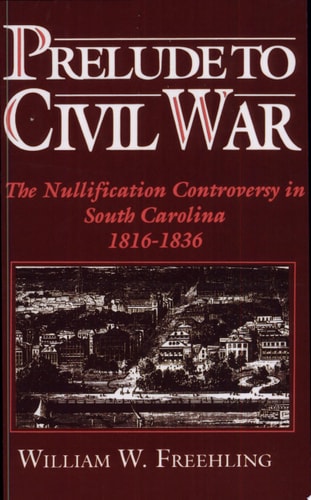
Prelude to Civil War: The Nullification Controversy in South Carolina, 1816-1836
0
0
As an Amazon Associate and affiliate partner, Menrva Books earns from qualifying purchases. Learn more
Author Description
When William Freehling's Prelude to Civil War first appeared in 1965 it was immediately hailed as a brilliant and incisive study of the origins of the Civil War. Book Week called it "fresh, exciting, and convincing," while The Virginia Quarterly Review praised it as, quite simply, "history at its best." It was equally well-received by historical societies, garnering the Allan Nevins History Prize as well as a Bancroft Prize, the most prestigious history award of all. Now once again available, Prelude to Civil War is still the definitive work on the subject, and one of the most important in ante-bellum studies.It tells the story of the Nullification Controversy in South Carolina, describing how from 1816 to 1836 aristocratic planters of the Palmetto State tumbled from a contented and prosperous life of elegant balls and fine Madeira wines to a world rife with economic distress, guilt over slavery, and apprehension of slave rebellion. It shows in compelling detail how this reversal of fortune led the political leaders of South Carolina down the path to ever more radical states rights doctrines: in 1832 they were seeking to nullify federal law by refusing to obey it; four years later some of them were considering secession.As the story unfolds, we meet a colorful and skillfully drawn cast of characters, among them John C. Calhoun, who hoped nullifcation would save both his highest priority, slavery, and his next priority, union; President Andrew Jackson, who threatened to hang Calhoun and lead federal troops into South Carolina; Denmark Vesey, who organized and nearly brought off a slave conspiracy; and Martin Van Buren, the "Little Magician," who plotted craftily to replace Calhoun in Jackson's esteem. These and other important figures come to life in these pages, and help to tell a tale--often in their own words--central to an understanding of the war which eventually engulfed the United States.Demonstrating how a profound sensitivity to the still-shadowy slavery iss
Menrva's Summary
THE THESIS
This work investigates how the Nullification Controversy in South Carolina between 1816 and 1836 served as a critical precursor to the American Civil War. William W. Freehling, a prominent historian of the American South, utilizes extensive primary source documentation and political correspondence to analyze the shift in South Carolina's political climate. He argues that the transition from economic prosperity to anxiety over slavery and potential rebellion drove the state's elite toward radical states' rights doctrines, ultimately setting the stage for secession.
THE SCOPE MAP
What You Will Find
- Detailed analysis of the Nullification Crisis and its impact on federal-state relations.
- Examination of the socioeconomic decline of the South Carolina planter class.
- Biographical portraits of key political figures including John C. Calhoun, Andrew Jackson, and Martin Van Buren.
- Exploration of the intersection between slavery, economic distress, and political radicalization.
THE AUTHORITY PERSPECTIVE
Historians and scholars consistently recognize this text as a foundational study of antebellum politics and the origins of the Civil War. Readers frequently note the depth of the research and the clarity with which the author connects individual political motivations to broader national crises.
Page Count:
416
Publication Date:
1992-06-04
Publisher:
Oxford University Press
ISBN-10:
0195076818
ISBN-13:
9780195076813
History
Nullification
Political History
Community Tags
Other Editions(2)
Similar Books

Reader Comments
Share Your Thoughts
No comments yet. Be the first to share your thoughts!