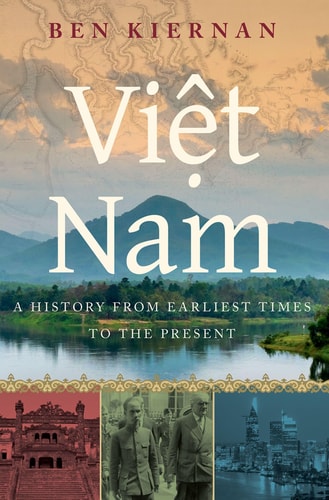
Viet Nam: A History from Earliest Times to the Present
0
0
As an Amazon Associate and affiliate partner, Menrva Books earns from qualifying purchases. Learn more
Author Description
For many Westerners, the name Vietnam evokes images of a bloody televised American war that generated a firestorm of protest and brought conflict into their living rooms. In his sweeping account, Ben Kiernan broadens this vision by narrating the rich history of the peoples who have inhabited the land now known as Viet Nam over the past three thousand years.Despite the tragedies of the American-Vietnamese conflict, Viet Nam has always been much more than a war. Its long history had been characterized by the frequent rise and fall of different political formations, from ancient chiefdoms to imperial provinces, from independent kingdoms to divided regions, civil wars, French colonies, and modern republics. In addition to dramatic political transformations, the region has been shaped by its environment, changing climate, and the critical importance of water, with rivers, deltas, and a long coastline facilitating agricultural patterns, trade, and communications.Kiernan weaves together the many narrative strands of Viet Nam's multi-ethnic populations, including the Chams, Khmers, and Vietnamese, and its multi-religious heritage, from local spirit cults to Buddhism, Confucianism, and Catholicism. He emphasizes the peoples' interactions over the millennia with foreigners, particularly their neighbors in China and Southeast Asia, in engagements ranging from military conflict to linguistic and cultural influences. He sets the tumultuous modern period--marked by French and Japanese occupation, anticolonial nationalism, the American-Vietnamese war, and communist victory--against the continuities evident in the deeper history of the people's relationships with the lands where they have lived. In contemporary times, he explores this one-party state's transformation into a global trading nation, the country's tense diplomatic relationship with China and developing partnership with the United States in maintaining Southeast Asia's regional security, and its uncertain prospects for
Menrva's Summary
THE THESIS
How has the long-term interaction between the diverse peoples of the region and their environment shaped the political and cultural identity of Viet Nam over three millennia? Ben Kiernan, a professor of history and director of the Genocide Studies Program at Yale University, utilizes extensive archaeological, linguistic, and historical records to construct a comprehensive narrative. He argues that the modern state of Viet Nam is best understood not merely through the lens of 20th-century warfare, but as the result of deep-seated continuities in land management, multi-ethnic integration, and regional diplomacy.
THE SCOPE MAP
What You Will Find
- A chronological survey spanning from ancient chiefdoms to the contemporary global trading era.
- Analysis of the environmental impact of water systems, deltas, and climate on agricultural development.
- Examination of the interactions between the Vietnamese, Chams, and Khmers alongside religious influences like Buddhism and Confucianism.
Scope Limits
- The text does not provide a granular, day-to-day military history of the American-Vietnamese conflict.
- It does not offer a speculative forecast of future political outcomes beyond current diplomatic trends.
THE AUTHORITY PERSPECTIVE
Historians and scholars frequently cite this work as a definitive, single-volume reference for understanding the breadth of Vietnamese history. Readers often note the academic density of the prose, which provides a rigorous, evidence-based framework for both students and specialists in Southeast Asian studies.
Page Count:
656
Publication Date:
2019-04-01
Publisher:
Oxford University Press
ISBN-10:
0190053798
ISBN-13:
9780190053796
History
New Used & Rental Textbooks
Vietnam
Asia
Political History
Southeast Asia
Cultural History
Asian History
Community Tags
Other Editions(2)
Similar Books





Reader Comments
Share Your Thoughts
No comments yet. Be the first to share your thoughts!