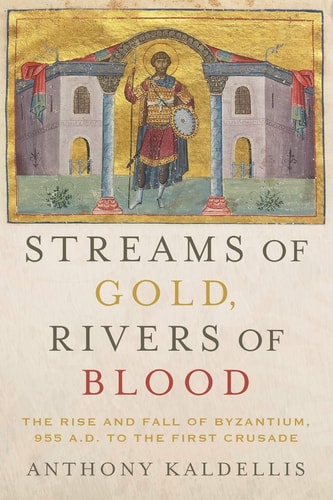
Streams of Gold, Rivers of Blood: The Rise and Fall of Byzantium, 955 A.D. to the First Crusade
0
0
As an Amazon Associate and affiliate partner, Menrva Books earns from qualifying purchases. Learn more
Author Description
In the second half of the tenth century, Byzantium embarked on a series of spectacular conquests: first in the southeast against the Arabs, then in Bulgaria, and finally in the Georgian and Armenian lands. By the early eleventh century, the empire was the most powerful state in the Mediterranean. It was also expanding economically, demographically, and, in time, intellectually as well. Yet this imperial project came to a crashing collapse fifty years later, when political disunity, fiscal mismanagement, and defeat at the hands of the Seljuks in the east and the Normans in the west brought an end to Byzantine hegemony. By 1081, not only was its dominance of southern Italy, the Balkans, Caucasus, and northern Mesopotamia over but Byzantium's very existence was threatened.How did this dramatic transformation happen? Based on a close examination of the relevant sources, this history-the first of its kind in over a century-offers a new reconstruction of the key events and crucial reigns as well as a different model for understanding imperial politics and wars, both civil and foreign. In addition to providing a badly needed narrative of this critical period of Byzantine history, Streams of Gold, Rivers of Blood offers new interpretations of key topics relevant to the medieval era. The narrative unfolds in three parts: the first covers the years 955-1025, a period of imperial conquest and consolidation of authority under the great emperor Basil "the Bulgar-Slayer." The second (1025-1059) examines the dispersal of centralized authority in Constantinople as well as the emergence of new foreign enemies (Pechenegs, Seljuks, and Normans). The last section chronicles the spectacular collapse of the empire during the second half of the eleventh century, concluding with a look at the First Crusade and its consequences for Byzantine relations with the powers of Western Europe. This briskly paced and thoroughly investigated narrative vividly brings to life one of the most exciting a
Menrva's Summary
THE THESIS
This work investigates the rapid ascent and subsequent disintegration of the Byzantine Empire between 955 A.D. and the First Crusade. Anthony Kaldellis, a prominent scholar of Byzantine history, utilizes primary source analysis to challenge traditional historiography regarding the empire's eleventh-century collapse. He proposes a new model for understanding the interplay between imperial politics, fiscal management, and military failure during this volatile era.
THE SCOPE MAP
What You Will Find
- A chronological narrative spanning the years 955 to 1081.
- Analysis of the reigns of key figures including Basil II.
- Examination of geopolitical shifts involving the Seljuks, Normans, and Pechenegs.
Scope Limits
- The text focuses specifically on the period leading up to the First Crusade and does not provide an exhaustive history of the entire Byzantine millennium.
- It prioritizes political and military structural analysis over social or cultural history.
THE AUTHORITY PERSPECTIVE
Experts recognize this work as a significant revisionist history that fills a long-standing gap in the study of the eleventh-century Byzantine state. Readers frequently note the academic rigor of the prose while appreciating the clarity with which the author navigates complex political transitions.
Page Count:
440
Publication Date:
2019-09-01
Publisher:
Oxford University Press
ISBN-10:
0190053208
ISBN-13:
9780190053208
History
Byzantine History
New Used & Rental Textbooks
Ancient History
Greece
Political History
Europe
Military History
Community Tags
Similar Books