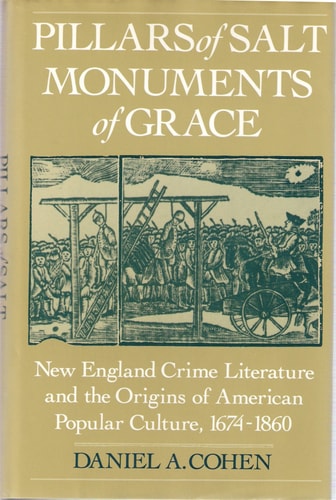
Pillars of Salt, Monuments of Grace: New England Crime Literature and the Origins of American Popular Culture, 1674-1860
0
0
As an Amazon Associate and affiliate partner, Menrva Books earns from qualifying purchases. Learn more
Author Description
The Commonwealth Center Studies in American Culture series presents innovative scholarship in the multidisciplinary study of American society and culture. Based on a nationally competitive search and sustained by a two-year fellowship at the Commonwealth Center for the Study of American Culture at the College of William and Mary, the series introduces the work of important young scholars and is both contemporary in approach and enduring in quality.Starting with the insight that crime and punishment have been among the most persistent and pervasive themes of American popular culture, this book demonstrates a major shift in their depiction from the colonial period to the Civil War. Through the systematic study of hundreds of early books, pamphlets, and broadsides, Cohen traces the declining authority of Puritan ministers and Calvinistic notions of sin and their replacement by a romantic, pluralistic literary marketplace where new professionals--lawyers, journalists, and even fiction writers--served as leading cultural arbiters. The book begins with a comprehensive survey of the entire field of crime literature in New England during the seventeenth and eighteenth centuries, focusing especially on execution sermons, conversion narratives, and criminal autobiographies. It not only explores the changing arguments of orthodox clergymen but also shows how the conventions of documentary reportage that they established gradually undermined their control of the public discourse, as criminals themselves gained a sometimes defiant literary voice. In the final chapters the focus shifts to two highly publicized sexual murder cases of the nineteenth century that illustrate new attitudes toward crime and new patterns of popular literature. Recovering a lost culture of legal romanticism--featuring trial reports, romantic biographies, and fictionalized docudramas--Cohen challenges the conventional assumption that there was a growing split between law and literature during the antebell
Menrva's Summary
THE THESIS
This book investigates the evolution of American crime literature from the colonial era to the Civil War, questioning how shifting cultural authorities transformed the public perception of sin and justice. Daniel A. Cohen, a scholar associated with the Commonwealth Center for the Study of American Culture, utilizes an extensive archive of early American printed materials to map this transition. He argues that the decline of Puritan ministerial influence allowed for the rise of a secular, romanticized literary marketplace where lawyers and journalists redefined the narrative of criminal behavior. By examining the shift from execution sermons to sensationalized trial reports, the work illustrates the emergence of modern popular culture.
THE SCOPE MAP
What You Will Find
- A comprehensive survey of New England crime literature spanning 1674 to 1860.
- Analysis of primary source materials including execution sermons, conversion narratives, and criminal autobiographies.
- Examination of the transition from Calvinistic moral frameworks to nineteenth-century legal romanticism.
- Case studies of highly publicized sexual murder trials that exemplify changing attitudes toward crime and media.
THE AUTHORITY PERSPECTIVE
Scholars recognize this work as a significant contribution to the study of early American print culture and the intersection of law and literature. Readers frequently note the academic density of the prose, which provides a rigorous, data-driven analysis of how criminal narratives shaped the American public consciousness.
Page Count:
368
Publication Date:
1993-03-04
Publisher:
Oxford University Press
ISBN-10:
0195075846
ISBN-13:
9780195075847
History
Sociology
Literary Criticism
In literature
Criminology
Criticism history
American History
Community Tags
Similar Books







Reader Comments
Share Your Thoughts
No comments yet. Be the first to share your thoughts!