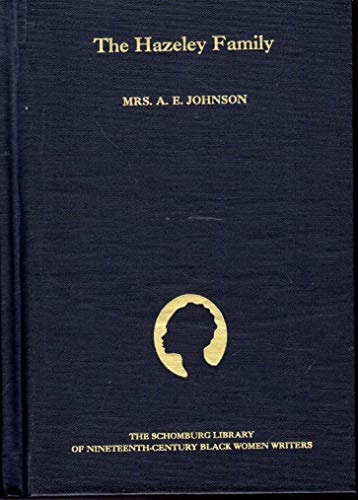
The Hazeley Family
0
0
As an Amazon Associate and affiliate partner, Menrva Books earns from qualifying purchases. Learn more
Author Description
When The Hazeley Family was first published by the American Baptist Publication Society in 1894, it was advertised as "a book that should be in every Sunday-School Library." A novel set in the North, The Hazeley Family is somewhat typical of the "angel of the home" romances written by American women during the latter half of the nineteenth century--except that the author is a black woman. The book is based on the belief that "a happy home is the acme of human bliss," and that women are central to the achievement of that acme. It is the moral fiber of Flora Hazeley, the central character, that keeps her family together--a constant concern in Afro-American literature and life. Featuring "nonracial" characters, this novel exemplifies one of the various tactics that many black writers used to overcome the racial stereotypes demanded by the white literary establishment.
Menrva's Summary
THE PULSE
The stability of the Hazeley household is threatened by external societal pressures, forcing the protagonist to maintain moral order within her domestic sphere. Flora Hazeley serves as the anchor for her family, navigating the expectations of late nineteenth-century social norms while striving to preserve the sanctity of her home. The narrative follows a traditional moralistic framework common to the era, emphasizing the role of the woman as the primary architect of family happiness. The story unfolds through a linear progression, focusing on the internal dynamics of the household and the character's adherence to virtuous conduct.
INSIDE THE PAGES
- Focus on the domestic sphere as a site of moral preservation
- Utilization of the 'angel of the home' literary archetype
- Emphasis on character-driven moral development
- Exploration of family unity as a central thematic concern
- Adoption of nonracial characterization as a literary strategy
- Representation of nineteenth-century social and religious values
- Didactic tone intended for Sunday-School library audiences
- Examination of the intersection between gender roles and cultural identity
THE COLLECTIVE ECHO
Discussion often centers on the author's deliberate use of nonracial characterization to navigate the restrictive literary landscape of the 1890s. Readers frequently highlight the contrast between the novel's conventional domestic themes and the unique position of a black woman author writing within that specific genre. Critics observe that the work provides a window into the moral priorities and social aspirations of the era's African American literary community. The pacing is noted for its steady, instructional quality, reflecting the book's original intent as a moral guide for young readers. Scholars emphasize that the text remains a significant artifact for understanding how black writers negotiated identity and representation during the post-Reconstruction period.
Page Count:
240
Publication Date:
1992-04-09
Publisher:
Oxford University Press
ISBN-10:
0195075773
ISBN-13:
9780195075779
Nineteenth century
Historical
Domestic fiction
African American
African Americans