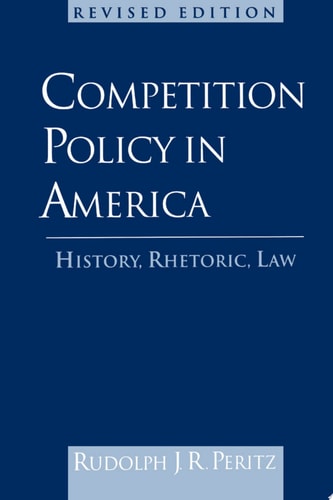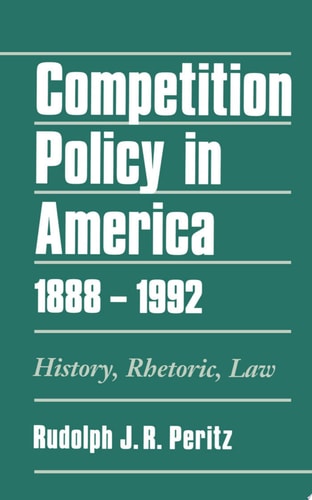
Competition Policy in America, 1888-1992: History, Rhetoric, Law
0
0
As an Amazon Associate and affiliate partner, Menrva Books earns from qualifying purchases. Learn more
Author Description
Americans have long appealed to images of free competition in calling for free enterprise, freedom of contract, free labor, free trade, and free speech. This imagery has retained its appeal in myriad aspects of public policy--for example, Senator Sherman's Anti-Trust Act of 1890, Justice Holmes's metaphorical marketplace of ideas, and President Reagan's rhetoric of deregulation.In Competition Policy in America, 1888-1992, Rudolph Peritz explores the durability of free competition imagery by tracing its influences on public policy. Looking at congressional debates and hearings, administrative agency activities, court opinions, arguments of counsel, and economic, legal, and political scholarship, he finds that free competition has actually evoked two different visions--freedom not only from oppressive government, but also from private economic power. He shows how the discourse of free competition has mediated between commitments to individual liberty and rough equality--themselves unstable over time. This rhetorical approach allows us to understand, for example, that the Reagan and Carter programs of deregulation, both inspired by the rhetoric of free competition, were driven by fundamentally different visions of political economy.Peritz's historical inquiry into competition policy as a series of government directives, inspired by two complex yet distinct and sometimes contradictory visions of free competition, provides an indispensable framework for understanding modern political economy-- whether political campaign finance reform, corporate takeover regulation, or current attitudes toward the New Deal Legacy. Competition Policy in America will be of great interest to lawyers, historians, economists, sociologists, and policy makers in both government and business.
Menrva's Summary
THE THESIS
How has the rhetoric of 'free competition' shaped the evolution of American public policy and legal frameworks from the late 19th century to the end of the 20th century? Rudolph J. R. Peritz, a scholar of law and political economy, examines the historical durability of competition imagery by analyzing congressional records, judicial opinions, and administrative actions. He argues that the concept of 'free competition' has functioned as a flexible, often contradictory, rhetorical tool used to justify both deregulation and government intervention. By tracing these shifts, the author demonstrates how the discourse has mediated the tension between individual liberty and the pursuit of economic equality.
THE SCOPE MAP
What You Will Find
- A historical analysis of American competition policy spanning from 1888 to 1992.
- An examination of the dual visions of free competition: freedom from government oppression versus freedom from private economic power.
- A review of primary source materials including congressional hearings, court opinions, and legal scholarship.
- A framework for interpreting modern political economy issues such as corporate regulation and the New Deal legacy.
THE AUTHORITY PERSPECTIVE
Experts recognize this work as a significant contribution to the intersection of legal history and economic policy. Readers frequently note the academic density of the prose, which provides a rigorous examination of how political rhetoric influences legislative outcomes.
Page Count:
384
Publication Date:
1996-02-01
Publisher:
Oxford University Press
ISBN-10:
0195074610
ISBN-13:
9780195074611
History
Economics
Public Policy
Competition
Law
Antitrust Law
Community Tags
Similar Books