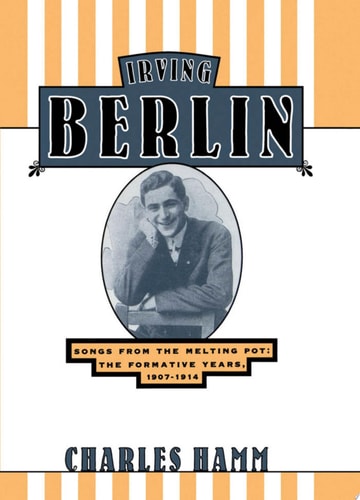
Irving Berlin: Songs from the Melting Pot: The Formative Years, 1907-1914
0
0
As an Amazon Associate and affiliate partner, Menrva Books earns from qualifying purchases. Learn more
Author Description
Irving Berlin remains a central figure in American music, a lyricist/composer whose songs are loved all over the world. His first piece, "Marie from Sunny Italy," was written in 1907, and his "Alexander's Ragtime Band" attracted more public and media attention than any other song of its decade. In later years Berlin wrote such classics as "God Bless America," "Blue Skies," "Always," "Cheek to Cheek," and the holiday favorites "White Christmas" and "Easter Parade." Jerome Kern, his fellow songwriter, commented that "Irving Berlin is American music."In Irving Berlin: The Formative Years, Charles Hamm traces the early years of this most famous and distinctive American songwriter. Beginning with Berlin's immigrant roots--he came to New York in 1893 from Russia--Hamm shows how the young Berlin quickly revealed the talent for music and lyrics that was to mark his entire career. Berlin first wrote for the vaudeville stage, turning out songs that drew on the various ethnic cultures of the city. These pieces, with their Jewish, Italian, German, Irish, and Black protagonists singing in appropriate dialects, reflected the urban mix of New York's melting pot. Berlin drew on various musical styles, especially ragtime, for such songs as "Alexander's Ragtime Band," and Hamm devotes an entire chapter to the song and its success. The book also details Berlin's early efforts to write for the Broadway musical stage, culminating in 1914 with his first musical comedy, Watch Your Step, featuring the popular dance team, Vernon and Irene Castle. A great hit on Broadway and in London, the show was a key piece in the Americanization of the musical comedy. Blessed with prodigious ambition and energy, Berlin wrote at least 4 or 5 new songs a week, many of which were discarded. He nevertheless published 190 songs between 1907 and 1914, an astonishing number considering that when Berlin arrived in America, he knew not a single word of English.
Menrva's Summary
THE THESIS
How did Irving Berlin’s immigrant background and the cultural landscape of early 20th-century New York shape the development of his foundational musical style? Charles Hamm, a respected musicologist, examines the intersection of Berlin’s rapid assimilation and the burgeoning American popular music industry. By analyzing the transition from vaudeville to Broadway, the author argues that Berlin’s early output functioned as a sonic reflection of the city’s diverse ethnic melting pot. The text utilizes archival song lists and historical context to map the evolution of a songwriter who arrived in America without knowledge of the English language.
THE SCOPE MAP
What You Will Find
- A detailed analysis of Berlin’s early songwriting output between 1907 and 1914.
- Examination of the influence of vaudeville and ethnic dialect songs on early American popular music.
- A dedicated study of the cultural impact and success of the song "Alexander’s Ragtime Band."
- Documentation of Berlin’s transition into Broadway musical comedy with the production of "Watch Your Step."
THE AUTHORITY PERSPECTIVE
Scholars and music historians frequently cite this work as a definitive account of Berlin’s early professional development. The text is noted for its rigorous archival research and its ability to contextualize popular music within the broader socio-economic history of New York City.
Page Count:
304
Publication Date:
1997-01-01
Publisher:
Oxford University Press
ISBN-10:
0195071883
ISBN-13:
9780195071887
Biography
History
Music
American History
Community Tags
Similar Books