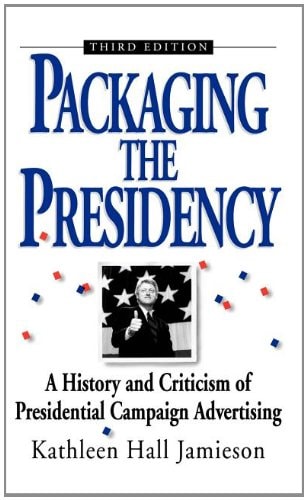
Packaging the Presidency: A History and Criticism of Presidential Campaign Advertising
0
0
As an Amazon Associate and affiliate partner, Menrva Books earns from qualifying purchases. Learn more
Author Description
"If political advertising did not exist, we would have to invent it," writes Katherine Hall Jamieson in her widely praised study, Packaging the Presidency. Now in a new Third Edition, Jamieson expands her authoritative analysis of political advertising, looking at the media campaigns of American presidents from the early days of the republic to the successful 1992 Clinton campaign. Chronicling the evolution of the campaign ad from political songs and slogans through the handbill and newspaper cartoon to radio and television coverage, an argument emerges that is subtle but persuasive: though often equivocal, and even downright sleazy, political advertising is vital in reminding voters of the choices at the heart of democracy.Much of the book, appropriately, focuses on the powerful media campaigns of the post-war period. In individual chapters devoted to presidential campaigns since 1952, the claims of media strategists, campaign memos, and journalists frame discussions on the impact of candidates from Adlai Stevenson, Richard Nixon, John F. Kennedy, and Ronald Reagan to the country's more recent high-profile and media savvy canditates such as Ross Perot and Bill Clinton. This new edition covers such issues as the new forms of exposition created by cable television that so powerfully impacted the 1992 campaign. The wide variety of venues, including MTV and the Nashville Network, coupled with almost daily appearances on morning talk shows, afforded candidates the ability to reach audiences by the millions in "news-ads" that served as free extended commercials. Jamieson points out the success of Ross Perot's unconventional revival of the thirty-minute program spot--an important innovation that reflected both the power of the modern-day "infomercial" and marked a radical change in previously held notions about the viewing electorate's response to longer forms of candidate sponsored communication. Jamieson also addresses the increasing prevalence of "adwatchs," in which t
Menrva's Summary
THE THESIS
How has the evolution of political advertising shaped the American democratic process and the way voters perceive presidential candidates? Kathleen Hall Jamieson, a prominent scholar in communication and political science, examines the historical trajectory of campaign messaging from the early republic to the 1992 election. By analyzing campaign memos, media strategies, and journalistic accounts, she argues that despite its often manipulative or negative nature, political advertising serves as a necessary mechanism for highlighting the choices inherent in a democratic system.
THE SCOPE MAP
What You Will Find
- A chronological history of campaign media, ranging from early political songs and handbills to modern television and cable spots.
- Analysis of post-war presidential campaigns, including detailed case studies of candidates from Adlai Stevenson to Bill Clinton.
- Examination of the shift toward "news-ads" and the impact of non-traditional media venues like MTV and morning talk shows.
- Evaluation of the "infomercial" format and the rise of "adwatch" segments in political journalism.
THE AUTHORITY PERSPECTIVE
Experts frequently cite this work as a foundational text for understanding the mechanics of American political communication and the development of campaign strategy. Readers often note the academic rigor and the depth of the historical research provided by the author.
Page Count:
608
Publication Date:
1996-06-20
Publisher:
Oxford University Press
ISBN-10:
0195089413
ISBN-13:
9780195089417
History
Politics
Communication
American History
United States
American Government
Media Studies
Community Tags
Similar Books