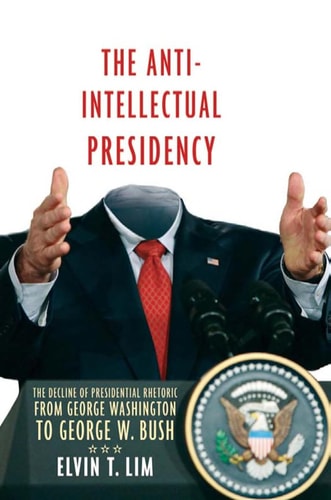
The Anti-Intellectual Presidency: The Decline of Presidential Rhetoric from George Washington to George W. Bush
0
0
As an Amazon Associate and affiliate partner, Menrva Books earns from qualifying purchases. Learn more
Author Description
Why has it been so long since an American president has effectively and consistently presented well-crafted, intellectually substantive arguments to the American public? Why have presidential utterances fallen from the rousing speeches of Lincoln, Teddy Roosevelt, Wilson, and FDR to a series of robotic repetitions of talking points and sixty-second soundbites, largely designed to obfuscate rather than illuminate?In The Anti-Intellectual Presidency, Elvin Lim draws on interviews with more than 40 presidential speechwriters to investigate this relentless qualitative decline, over the course of 200 years, in our presidents' ability to communicate with the public. Lim argues that the ever-increasing pressure for presidents to manage public opinion and perception has created a "pathology of vacuous rhetoric and imagery" where gesture and appearance matter more than accomplishment and fact. Lim tracks the campaign to simplify presidential discourse through presidential and speechwriting decisions made from the Truman to the present administration, explaining how and why presidents have embraced anti-intellectualism and vague platitudes as a public relations strategy. Lim sees this anti-intellectual stance as a deliberate choice rather than a reflection of presidents' intellectual limitations. Only the smart, he suggests, know how to dumb down. The result, he shows, is a dangerous debasement of our political discourse and a quality of rhetoric which has been described, charitably, as "a linguistic struggle" and, perhaps more accurately, as "dogs barking idiotically through endless nights."Sharply written and incisively argued, The Anti-Intellectual Presidency sheds new light on the murky depths of presidential oratory, illuminating both the causes and consequences of this substantive impoverishment.
Menrva's Summary
THE THESIS
This book investigates the historical decline of substantive presidential rhetoric and the deliberate shift toward anti-intellectual communication strategies in American politics. Elvin T. Lim, a scholar of political science, examines the evolution of executive speech from the founding era to the early 21st century. By analyzing the transition from complex, oratorical discourse to simplified soundbites, Lim argues that this trend is a calculated public relations maneuver rather than a reflection of individual presidential intelligence. The work utilizes extensive primary research to demonstrate how the pressure to manage public perception has fundamentally altered the nature of democratic leadership.
THE SCOPE MAP
What You Will Find
- A longitudinal analysis of presidential rhetoric spanning from George Washington to George W. Bush.
- Qualitative data derived from interviews with over 40 former presidential speechwriters.
- A theoretical framework explaining the "pathology of vacuous rhetoric" as a strategic choice.
- Examination of the shift in political discourse from substantive argument to image-based messaging.
THE AUTHORITY PERSPECTIVE
Experts and political historians frequently cite this work as a foundational text for understanding the mechanics of modern executive communication. Readers often note the academic rigor of the research, which provides a sobering look at the long-term degradation of political discourse in the United States.
Page Count:
208
Publication Date:
2008-06-16
Publisher:
Oxford University Press
ISBN-10:
019534264X
ISBN-13:
9780195342642
Politics
History
Government
Communication
American History
Communication in politics
United States
Community Tags
Similar Books