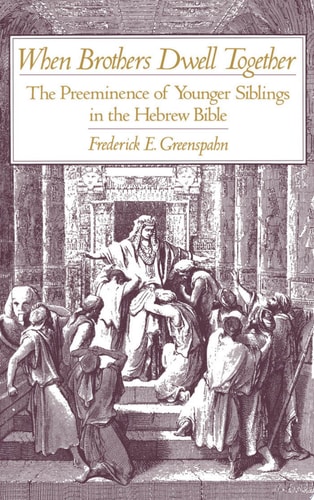
When Brothers Dwell Together: The Preeminence of Younger Siblings in the Hebrew Bible
0
0
As an Amazon Associate and affiliate partner, Menrva Books earns from qualifying purchases. Learn more
Author Description
Although primogeniture is commonly assumed to have prevailed throughout the world and firstborns are regarded as most likely to achieve success, many of the most prominent figures in biblical literature are younger offspring, including Isaac, Jacob, Joseph, Moses, Samuel, David, and Solomon. Central to the plot of most biblical stories, the sibling relationships depicted are rarely harmonious, and the surprising preference for younger siblings is an intriguing and unexplained pattern. Using evidence from a wide range of disciplines. Frederick E. Greenspahn presents a seminal interpretation of this phenomenon. In this study, he demonstrates that ancient Israelite fathers were in fact free to choose their primary heirs. The Bible's propensity for younger offspring, Greenspahn shows, reflects neither a legally mandated norm nor a protest against the prevailing custom, but rather conforms to a widespread folk motif, evoking innocence, vulnerability, and destiny. Within the biblical context, this theme heightens God's role in supporting ostensibly unlikely heroes. Drawing on the resources of law, anthropology, folklore, and linguistics, Greenspahn shows how, in portraying younger siblings triumphing over older ones, these tales serve as complex parables of God's relationship to his chosen people, and reflect Israel's own discomfort with the contradiction between its theology of election and the reality of political weakness.
Menrva's Summary
THE THESIS
This study investigates the recurring pattern of younger siblings achieving prominence over their older counterparts within the narratives of the Hebrew Bible. Frederick E. Greenspahn, a scholar of biblical literature, utilizes a multidisciplinary approach to challenge the assumption that primogeniture was the absolute legal standard in ancient Israel. By synthesizing legal, anthropological, and linguistic evidence, he argues that the preference for younger offspring functions as a theological and cultural motif rather than a reflection of actual inheritance law.
THE SCOPE MAP
What You Will Find
- Analysis of prominent biblical figures including Isaac, Jacob, Joseph, Moses, Samuel, David, and Solomon.
- Examination of ancient Near Eastern inheritance customs and legal practices regarding primogeniture.
- Integration of folklore motifs to explain the symbolic significance of the younger sibling archetype.
- Exploration of the theological implications of divine election in the context of political vulnerability.
THE AUTHORITY PERSPECTIVE
Scholars recognize this work as a significant contribution to the study of biblical narrative structures and social history. The text is frequently cited for its ability to bridge the gap between legal history and literary analysis, providing a nuanced understanding of how ancient Israelite culture utilized family dynamics to articulate theological concepts.
Page Count:
193
Publication Date:
1994-02-24
Publisher:
Oxford University Press
ISBN-10:
0195082532
ISBN-13:
9780195082531
Religion
History
Anthropology
Folklore
Theology