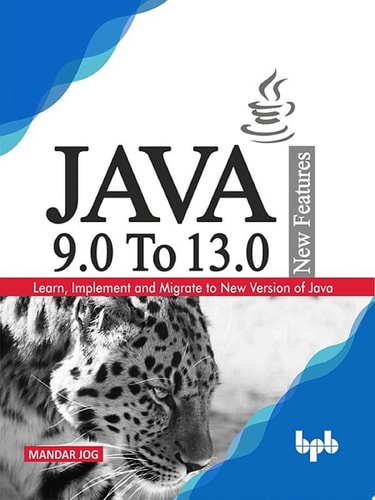
Java 9.0 to 13.0 New Features
0
0
As an Amazon Associate and affiliate partner, Menrva Books earns from qualifying purchases. Learn more
Author Description
Version release is one of the important phases of success of any programming language. Over the years, Java had made many improvements in its API to make to reliable and flexible to use. This book aims at providing you information related to all the updates from JDK9.0 to JDK13.0 in one place. This book starts with a brief history of Java. It covers how Java has evolved as a complete programming language over the years by launching different versions. You will learn the concept of module system and other important concepts introduced in JSE9.0 and JSE10.0. Moving ahead, the book will take you through updates in JDK11.0. Concepts like Epsilon, ZGC, and Nest-Based access control have also been discussed. Though the version updates are good to learn, they create complexities in updating the existing code to make it compatible with the new version. This book talks in detail about how you can migrate your legacy code to match up with the new versions. It also covers how to use jshell, a tool used to test your code snippet without writing the complete application class, with numerous examples. Further, this book covers in detail the concept of reactive programming. Concepts like publisher, subscriber, subscription and back-pressure have been discussed with examples. At the end of the book, you will learn about the very recent updates which have been released by Java. The chapters talk about JDK12.0 and JDK13.0. They cover concepts like Shenondaoh, microbenchmark suit, modified switch expression from JDK12.0. Though Java13 is still a hot-plated dish, this book gives you a fair idea about what are the new updates which have been proposed in this version.
Menrva's Summary
THE THESIS
This book details the significant new features and updates introduced in Java Development Kit (JDK) versions 9.0 through 13.0. The author provides a historical overview of Java's evolution, focusing on the advancements and conceptual shifts in JSE 9.0 and 10.0, including the module system. Subsequent chapters explore updates in JDK 11.0, such as the Epsilon garbage collector, Z Garbage Collector (ZGC), and Nest-Based Access Control, while also addressing the complexities of migrating legacy code to these newer versions. The book further introduces the `jshell` tool for code snippet testing and delves into reactive programming concepts like publisher, subscriber, subscription, and back-pressure, concluding with an examination of JDK 12.0 and 13.0 features like Shenandoah, the microbenchmark suite, and modified switch expressions.
THE SCOPE MAP
- History of Java and its version evolution
- Module system and key concepts in JSE 9.0 and JSE 10.0
- Updates in JDK 11.0: Epsilon, ZGC, Nest-Based Access Control
- Strategies and techniques for migrating legacy Java code
- Introduction to `jshell` for testing code snippets
- Detailed explanation of reactive programming concepts (publisher, subscriber, subscription, back-pressure)
- New features in JDK 12.0: Shenandoah, microbenchmark suite, modified switch expression
- Overview of proposed updates in JDK 13.0
THE AUTHORITY PERSPECTIVE
This technical guide appears to offer a comprehensive overview of recent Java Development Kit updates, targeting developers seeking to understand and implement new features. The detailed chapter breakdown suggests a practical approach, covering migration strategies and modern programming paradigms like reactive programming. The inclusion of specific features like ZGC and `jshell` indicates a focus on current industry practices and tools, positioning it as a valuable resource for developers working with Java versions 9 through 13.
Page Count:
260
Publication Date:
2019-01-01
Publisher:
BPB Publications
ISBN-10:
9389328608
ISBN-13:
9789389328608
Non-Fiction
Science & Technology
Programming
Java
Computer Science
Community Tags
Similar Books