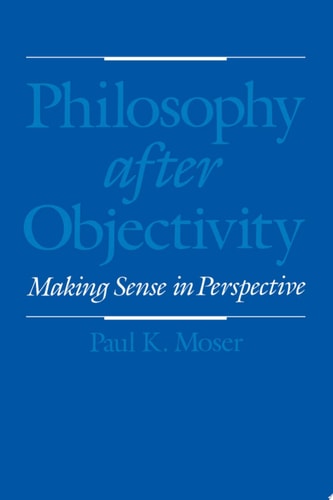
Philosophy after Objectivity: Making Sense in Perspective
0
0
As an Amazon Associate and affiliate partner, Menrva Books earns from qualifying purchases. Learn more
Author Description
Since the beginning of philosophy, philosophers have sought objective knowledge: knowledge of things whose existence does not depend on one's conceiving of them. This book uses lessons from debates over objective knowledge to characterize the kinds of reasons pertinent to philosophical and other theoretical views. It argues that we cannot meet skeptics' typical demands for nonquestion-begging support for claims to objective truth, and that therefore we should not regard our supporting reasons as resistant to skeptical challenges. One key lesson is that a constructive, explanatory approach to philosophy must change the subject from skeptic-resistant reasons to perspectival reasons arising from variable semantic commitments and instrumental, purpose-relative considerations. The book lays foundations for such a reorientation of philosophy, treating fundamental methodological issues in ontology, epistemology, the theory of meaning, the philosophy of mind, and the theory of practical rationality. It explains how certain perennial debates in philosophy rest not on genuine disagreement, but on conceptual diversity: talk about different matters. The book shows how acknowledgment of conceptual diversity can resolve a range of traditional disputes in philosophy. It also explains why philosophers need not anchor their discipline in the physicalism of the natural sciences.
Menrva's Summary
THE THESIS
Can philosophy maintain its relevance and rigor if it abandons the traditional pursuit of objective, skeptic-resistant knowledge? Paul K. Moser, a prominent philosopher, examines the limitations of seeking objective truth in the face of skeptical challenges. He argues that the discipline should pivot toward a perspectival framework, where reasons are understood as variable, purpose-relative, and rooted in specific semantic commitments rather than universal, mind-independent facts.
THE SCOPE MAP
What You Will Find
- A critical analysis of the historical pursuit of objective knowledge in Western philosophy.
- A proposed methodological shift from skeptic-resistant reasoning to perspectival, instrumental reasoning.
- An examination of conceptual diversity as a tool for resolving perennial philosophical disputes.
- Theoretical foundations spanning ontology, epistemology, philosophy of mind, and practical rationality.
THE AUTHORITY PERSPECTIVE
Experts recognize this work as a significant contribution to contemporary meta-philosophical discourse, particularly for its challenge to the dominance of physicalism. Readers frequently note the academic density of the prose, which is intended for advanced students and professional philosophers engaged in rigorous methodological debate.
Page Count:
280
Publication Date:
1993-06-24
Publisher:
Oxford University Press
ISBN-10:
0195081099
ISBN-13:
9780195081091
Philosophy
Epistemology
Relativity
Metaphysics
Ontology
Realism
Objectivity
Community Tags
Similar Books