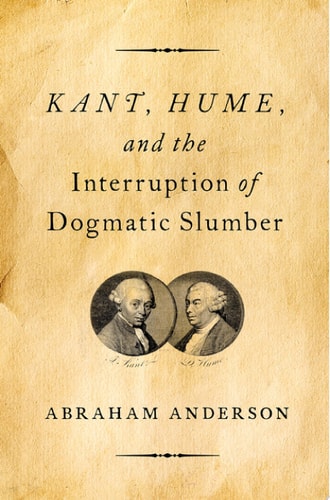
Kant, Hume, and the Interruption of Dogmatic Slumber
0
0
As an Amazon Associate and affiliate partner, Menrva Books earns from qualifying purchases. Learn more
Author Description
Kant once famously declared in the Prolegomena that "it was the objection of David Hume that first, many years ago, interrupted my dogmatic slumber." Abraham Anderson here offers an interpretation of this utterance, arguing that Hume roused Kant not (as has often been thought) by challenging the principle that "every event has a cause" which governs experience, but rather by attacking the principle of sufficient reason, the basis of both rationalist metaphysics and the cosmological proof of the existence of God. This suggestion, Anderson proposes, allows us to reconcile Kant's declaration with his later assertion that it was the Antinomy of pure reason - the clash of opposing theses - that first woke him from dogmatic slumber. For the Antinomy suspends the dogmatic principle of sufficient reason; in doing so, Anderson proposes, it is extending Hume's attack on that principle. This reading of Kant also explains why Kant speaks of "the objection of David Hume" after mentioning Hume's attack on metaphysics. The "objection" that Kant has in mind, Anderson argues, is a challenge to metaphysics, rather than to the foundations of empirical knowledge. Consequently, Anderson's analysis issues a new view of Hume himself-as primarily interested, not in the foundations of experience, but in the problem of metaphysics and theology. It thereby positions Kant and Hume as champions of the Enlightenment in its struggle with superstition. Shedding new light on the connection between two of the most influential figures in the history of philosophy, this volume will appeal not only to scholars of Kant, Hume, and early modern philosophy, but to philosophers and students interested in the history of philosophy and metaphysics generally.
Menrva's Summary
THE THESIS
This work investigates the specific philosophical challenge posed by David Hume that prompted Immanuel Kant to abandon his dogmatic approach to metaphysics. Abraham Anderson, a scholar of early modern philosophy, argues that Hume’s influence on Kant centered on the critique of the principle of sufficient reason rather than the causality of empirical experience. By re-evaluating Kant’s references to the Antinomy of pure reason, the author posits that both thinkers were primarily engaged in a project to dismantle metaphysical superstition.
THE SCOPE MAP
What You Will Find
- A re-interpretation of Kant's Prolegomena and the nature of his dogmatic slumber.
- An analysis of the principle of sufficient reason as the foundation of rationalist metaphysics.
- A comparative study of Hume’s skepticism and Kant’s critical philosophy.
Scope Limits
- The text does not provide a comprehensive biography of either philosopher.
- The analysis focuses specifically on metaphysical and theological implications rather than broader political or ethical theories.
THE AUTHORITY PERSPECTIVE
Scholars of early modern philosophy view this text as a specialized contribution to the ongoing debate regarding the intellectual lineage between Hume and Kant. Readers frequently note the academic density of the prose, which is intended for those already familiar with the technical terminology of transcendental idealism and rationalist metaphysics.
Page Count:
204
Publication Date:
2020-01-01
Publisher:
Oxford University Press
ISBN-10:
0190096764
ISBN-13:
9780190096762
Philosophy
Enlightenment Philosophy
Metaphysics
Sufficient reason
History & Surveys
Philosophy history
Epistemology
God
Influence Literary artistic etc
Community Tags
Similar Books