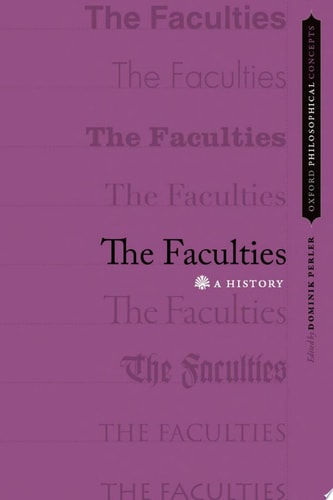
The Faculties: A History
0
0
As an Amazon Associate and affiliate partner, Menrva Books earns from qualifying purchases. Learn more
Author Description
It seems quite natural to explain the activities of human and non-human animals by referring to their special faculties. Thus, we say that dogs can smell things in their environment because they have perceptual faculties, or that human beings can think because they have rational faculties. But what are faculties? In what sense are they responsible for a wide range of activities? How can they be individuated? How are they interrelated? And why are different types of faculties assigned to different types of living beings?The six chapters in this book discuss these questions, covering a wide period from Plato up to contemporary debates about faculties as modules of the mind. They show that faculties were referred to in different theoretical contexts, but analyzed in radically different ways. Some philosophers, especially Aristotelians, made them the cornerstone of their biological and psychological theories, taking them to be basic powers of living beings. Others took them to be inner causes that literally produce activities, while still others provided a purely functional explanation. The chapters focus on various models, taking into account Greek, Arabic, Latin, French, German and Anglo-American debates. They analyze the role assigned to faculties in metaphysics, philosophy of mind and epistemology, but also the attack that was often launched against the assumption that faculties are hidden yet real features of living beings. The short "Reflections" inserted between the chapters make clear that faculties were also widely discussed in literature, science and medicine.
Menrva's Summary
THE THESIS
This book investigates the historical development and conceptual evolution of the notion of 'faculties' as explanatory tools for the activities of living beings. Dominik Perler, a scholar specializing in medieval and early modern philosophy, examines how various thinkers from antiquity to the present have defined, categorized, and critiqued the concept of mental and biological powers. The work argues that the understanding of faculties has shifted significantly across different theoretical contexts, moving from Aristotelian biological foundations to contemporary modular theories of the mind.
THE SCOPE MAP
What You Will Find
- A historical survey spanning from Plato to modern cognitive science.
- Analysis of diverse philosophical traditions including Greek, Arabic, Latin, French, German, and Anglo-American thought.
- Examination of the role of faculties in metaphysics, epistemology, and philosophy of mind.
- Interdisciplinary 'Reflections' connecting philosophical inquiry to literature, science, and medicine.
Scope Limits
- The text does not provide a comprehensive manual for modern psychological testing or clinical diagnosis.
- It does not attempt to resolve the contemporary scientific debate regarding the existence of mental modules.
THE AUTHORITY PERSPECTIVE
Scholars and students of intellectual history frequently cite this work as a rigorous, multi-disciplinary examination of a central, yet often overlooked, philosophical concept. Experts highlight the text's ability to synthesize complex historical debates into a coherent narrative that remains accessible to those with a background in philosophical inquiry.
Page Count:
354
Publication Date:
2015-01-01
Publisher:
Oxford University Press
ISBN-10:
0190273313
ISBN-13:
9780190273316
Philosophy
Philosophy history
Personality
Epistemology
Mind & Body
Metaphysics
Ability
Philosophy of
Intellect
Intellectual History
Community Tags
Similar Books