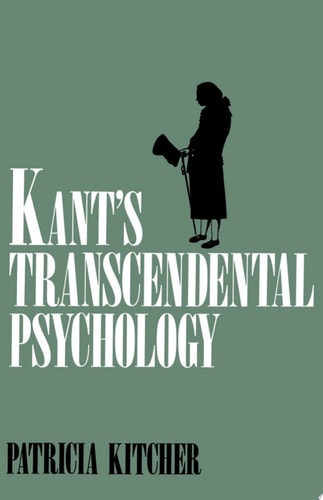
Kant's Transcendental Psychology
0
0
As an Amazon Associate and affiliate partner, Menrva Books earns from qualifying purchases. Learn more
Author Description
For the last 100 years historians have denigrated the psychology of the Critique of Pure Reason. In opposition, Patricia Kitcher argues that we can only understand the deduction of the categories in terms of Kant's attempt to fathom the psychological prerequisites of thought, and that this investigation illuminates thinking itself. Kant tried to understand the "task environment" of knowledge and thought: Given the data we acquire and the scientific generalizations we make, what basic cognitive capacities are necessary to perform these feats? What do these capacities imply about the inevitable structure of our knowledge? Kitcher specifically considers Kant's claims about the unity of the thinking self; the spatial forms of human perceptions; the relations among mental states necessary for them to have content; the relations between perceptions and judgment; the malleability essential to empirical concepts; the structure of empirical concepts required for inductive inference; and the limits of philosophical insight into psychological processes.
Menrva's Summary
THE THESIS
This book investigates whether Immanuel Kant's Critique of Pure Reason can be properly understood through the lens of his psychological prerequisites for human thought. Patricia Kitcher, a philosopher specializing in cognitive science and Kantian studies, challenges the century-long academic dismissal of Kant's psychological claims. By analyzing the deduction of categories, she argues that Kant’s work provides a coherent framework for understanding the cognitive capacities required for knowledge acquisition and scientific reasoning.
THE SCOPE MAP
What You Will Find
- An analysis of the unity of the thinking self and its role in cognitive structure.
- An examination of the relationship between spatial perception and mental state content.
- A detailed study of the connection between empirical concepts and inductive inference.
- A philosophical evaluation of the limits of human insight into psychological processes.
THE AUTHORITY PERSPECTIVE
Experts recognize this work as a significant intervention in Kantian scholarship that bridges the gap between classical philosophy and contemporary cognitive science. Readers frequently note the academic density of the prose, which requires a strong background in both transcendental idealism and modern psychological theory.
Page Count:
312
Publication Date:
1993-09-30
Publisher:
Oxford University Press
ISBN-10:
0195085639
ISBN-13:
9780195085631
Psychology
Philosophy
Epistemology
Psychology