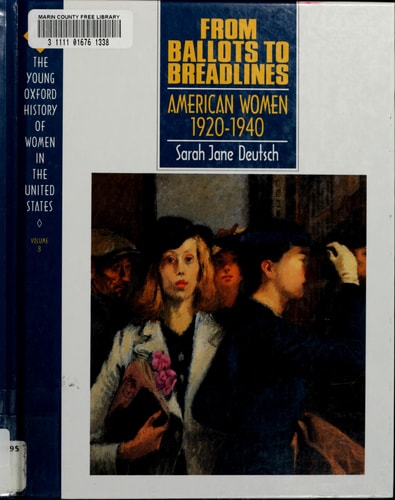
From Ballots to Breadlines: American Women 1920-1940
0
0
As an Amazon Associate and affiliate partner, Menrva Books earns from qualifying purchases. Learn more
Author Description
The years between the two World Wars were decades of contrasts. The Roaring Twenties are remembered as years of prosperity and frivolity that were ended abruptly by the Great Depression of the 1930s. The Republican-dominated, pro-business politics of the 1920s gave way to the Democratic activism of the New Deal. But for women there was continuity to these years, as their ability to effect change in political, cultural, and economic arenas of life began to gain strength.Radio, movies, and mass advertising took the country by storm, and for the first time women were recognized as prime consumers. This "new woman" could legally vote on the same basis as men everywhere in the United States. She wore clothes that scandalized her grandparents but were far more comfortable than anything her mother ever wore. She was being elected to public office, was leading peace movements, and demanded better health care for women and children. And in the 1930s she found in Eleanor Roosevelt a role model who was recognized internationally as a leading influence in American policy. American women felt a freedom never imagined by earlier generations.But some women did not share in this emancipation. Black women, Jewish women, Native American women--they found many of the newly opened doors slammed shut for them. They labored as clerical workers, domestic servants, farm or factory workers, not for self-fulfillment or liberation, but because their paychecks were needed to put food on the table. Even in the prosperous days of the flapper, some women faced a daily battle for survival.From Ballots to Breadlines takes American women from the euphoria of the 1920s to the sober reality of the 1930s. As they began to vote and bring home wages, a woman's role began to change, and with it the traditional image of the American family.
Menrva's Summary
THE THESIS
This work investigates how the social, political, and economic status of American women evolved during the volatile transition from the post-suffrage prosperity of the 1920s to the economic hardship of the 1930s. Sarah Jane Deutsch, a historian specializing in American social history, utilizes a comparative framework to analyze the experiences of diverse groups of women. She argues that while the era offered unprecedented opportunities for political participation and cultural influence, these gains were unevenly distributed across racial and socioeconomic lines. The text examines how the emergence of the 'new woman' coexisted with the persistent struggles of marginalized populations during the Great Depression.
THE SCOPE MAP
What You Will Find
- Analysis of the shift from 1920s consumerism to 1930s economic survival.
- Examination of the impact of the New Deal on female political activism.
- Comparative study of experiences among Black, Jewish, and Native American women.
- Documentation of the changing role of women in the workforce and the American family structure.
THE AUTHORITY PERSPECTIVE
Historians and educators frequently cite this volume as a reliable, accessible resource for understanding the complexities of gender roles in early 20th-century America. The text is noted for its ability to balance broad historical trends with the specific, often overlooked experiences of minority women during the interwar period.
Page Count:
144
Publication Date:
1994-09-22
Publisher:
Oxford University Press
ISBN-10:
0195080637
ISBN-13:
9780195080636
History
Social History
American History
United States
Women
Community Tags
Similar Books