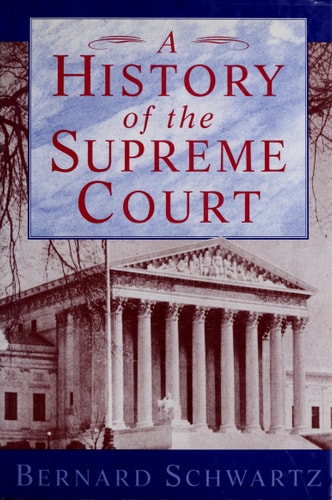
A History of the Supreme Court
0
0
As an Amazon Associate and affiliate partner, Menrva Books earns from qualifying purchases. Learn more
Author Description
When the first Supreme Court convened in 1790, it was so ill-esteemed that its justices frequently resigned in favor of other pursuits. John Rutledge stepped down as Associate Justice to become a state judge in South Carolina; John Jay resigned as Chief Justice to run for Governor of New York; and Alexander Hamilton declined to replace Jay, pursuing a private law practice instead. As Bernard Schwartz shows in this landmark history, the Supreme Court has indeed travelled a long and interesting journey to its current preeminent place in American life.In A History of the Supreme Court, Schwartz provides the finest, most comprehensive one-volume narrative ever published of our highest court. With impeccable scholarship and a clear, engaging style, he tells the story of the justices and their jurisprudence--and the influence the Court has had on American politics and society. With a keen ability to explain complex legal issues for the nonspecialist, he takes us through both the great and the undistinguised Courts of our nation's history. He provides insight into our foremost justices, such as John Marshall (who established judicial review in Marbury v. Madison, an outstanding display of political calculation as well as fine jurisprudence), Roger Taney (whose legacy has been overshadowed by Dred Scott v. Sanford), Oliver Wendell Holmes, Louis Brandeis, Benjamin Cardozo, and others. He draws on evidence such as personal letters and interviews to show how the court has worked, weaving narrative details into deft discussions of the developments in constitutional law. Schwartz also examines the operations of the court: until 1935, it met in a small room under the Senate--so cramped that the judges had to put on their robes in full view of the spectators. But when the new building was finally opened, one justice called it "almost bombastically pretentious," and another asked, "What are we supposed to do, ride in on nine elephants?" He includes fascinating asides, on the debate
Menrva's Summary
THE THESIS
How did the Supreme Court evolve from an obscure, ill-esteemed institution into the preeminent arbiter of American law and society? Bernard Schwartz, a noted legal scholar, utilizes extensive primary source material, including personal correspondence and historical records, to construct a comprehensive narrative of the Court's development. By examining the jurisprudence of key justices and the shifting political landscape of the United States, Schwartz argues that the Court's authority is a product of both strategic political calculation and evolving constitutional interpretation.
THE SCOPE MAP
What You Will Find
- A chronological account of the Supreme Court from its inception in 1790 through the modern era.
- Analysis of landmark cases such as Marbury v. Madison and Dred Scott v. Sanford.
- Biographical insights into influential figures including John Marshall, Roger Taney, and Oliver Wendell Holmes.
- Examination of the internal operations, physical environment, and administrative history of the Court.
THE AUTHORITY PERSPECTIVE
Legal scholars and historians frequently cite this work as a foundational, accessible text for understanding the institutional history of the judiciary. Readers often note the clarity of the prose, which successfully translates complex constitutional developments for a general audience.
Page Count:
480
Publication Date:
1993-10-07
Publisher:
Oxford University Press
ISBN-10:
0195080998
ISBN-13:
9780195080995
Biography
History
Politics
American History
Law
United States
Community Tags
Similar Books