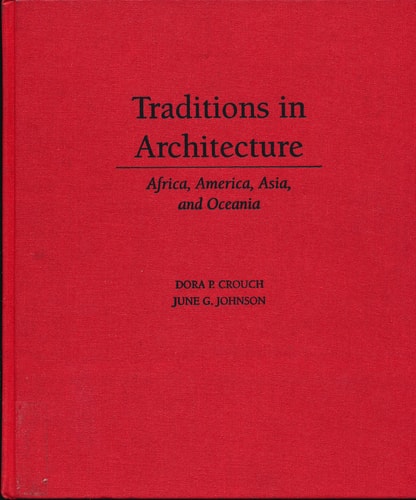
Traditions in Architecture: Africa, America, Asia, and Oceania
0
0
As an Amazon Associate and affiliate partner, Menrva Books earns from qualifying purchases. Learn more
Author Description
Product Description This book introduces students, professionals and the general public to the architectural achievements of diverse cultures outside the Euroamerican tradition. Rather than concentrating on geographic or chronological categories, however, the authors have arranged their subject matterthematically in order to focus on the basic needs common to all human communities. The book is divided into five major sections, each of which deals with vernacular as well as monumental structures. These five topics are discussed in terms of particular architectural solutions, comparing and contrasting geographically separated buildings and construction traditions. Forexample, the issue of architectural meaning is studied through symbolic gardens in China, verbal ornament in the Islamic world, and the wall paintings of Ndebele women of southeast Africa. Theoretical issues related to particular building traditions are illuminated by these juxtapositions. Traditions in Architecture begins with an investigation into the ways in which the continuity of traditional forms is maintained. Next, the authors explore practical issues such as housing and food structures, climate and ecology, building materials, and architectural forms and methods.Architectural goals and purposes, which determine what is built, vary from culture to culture and are given special attention. Planning and design -- ways in which space is used in patterns of organization -- constitute a discussion ranging from urban plans to landscaped settings. The text concludeswith an examination of cultural values, investigating the interaction between architecture and social relations, traditional theories, decision-making, and the economics of building. About the Author Dora P. Crouch is Professor Emeritus at Rensselaer Polytechnic Institute. June G. Johnson is Lecturer in the Department of Agriculture at El Camino Community College.
Menrva's Summary
THE THESIS
How do diverse human communities across Africa, America, Asia, and Oceania address universal needs through distinct architectural traditions? Dora P. Crouch, a Professor Emeritus, and June G. Johnson, a lecturer in agriculture, utilize a thematic framework to analyze architectural achievements outside of Eurocentric models. By moving away from strictly chronological or geographic categorization, the authors argue that human building practices are best understood through the lens of shared functional and symbolic requirements. The text synthesizes cross-cultural case studies to demonstrate how climate, ecology, and social values dictate the evolution of both vernacular and monumental structures.
THE SCOPE MAP
What You Will Find
- Comparative analysis of architectural solutions across four continents including Africa, America, Asia, and Oceania.
- Examination of practical building factors such as climate, ecology, and material selection.
- Investigation into the role of symbolic meaning in architecture, ranging from Chinese gardens to Islamic ornamentation.
- Discussion of urban planning, spatial organization, and the socio-economic drivers of construction.
THE AUTHORITY PERSPECTIVE
Experts and educators frequently cite this work as a foundational text for introducing students to non-Western architectural history. Readers note that the thematic organization provides a clear, accessible entry point for understanding complex cultural building practices without requiring extensive prior technical knowledge.
Page Count:
448
Publication Date:
2000-01-01
Publisher:
Oxford University Press
ISBN-10:
0195088905
ISBN-13:
9780195088908
Architecture
History
United States
Anthropology
Architecture asia
Community Tags
Similar Books