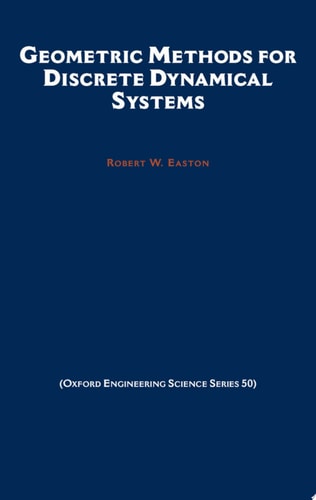
Geometric Methods for Discrete Dynamical Systems
0
0
As an Amazon Associate and affiliate partner, Menrva Books earns from qualifying purchases. Learn more
Author Description
This book looks at dynamics as an iteration process where the output of a function is fed back as an input to determine the evolution of an initial state over time. The theory examines errors which arise from round-off in numerical simulations, from the inexactness of mathematical models used to describe physical processes, and from the effects of external controls. The author provides an introduction accessible to beginning graduate students and emphasizing geometric aspects of the theory. Conley's ideas about rough orbits and chain-recurrence play a central role in the treatment. The book will be a useful reference for mathematicians, scientists, and engineers studying this field, and an ideal text for graduate courses in dynamical systems.
Menrva's Summary
THE THESIS
This text investigates the application of geometric methods to understand the evolution and stability of discrete dynamical systems. Robert W. Easton, drawing on his expertise in mathematical analysis, provides a structured framework for analyzing iteration processes. The book addresses the inherent errors found in numerical simulations and physical modeling, utilizing Conley's theory of rough orbits and chain-recurrence to provide a rigorous yet accessible introduction for graduate-level study.
THE SCOPE MAP
What You Will Find
- Analysis of iteration processes as a method for determining state evolution over time
- Examination of error propagation resulting from round-off and model inexactness
- Application of Conley's geometric theory regarding rough orbits and chain-recurrence
- Methodologies for incorporating external controls into dynamical system modeling
THE AUTHORITY PERSPECTIVE
Experts identify this work as a foundational text for graduate students and researchers in engineering and mathematics. Readers frequently note the technical density of the prose, which is balanced by a clear focus on geometric intuition.
Page Count:
176
Publication Date:
1998-02-26
Publisher:
Oxford University Press
ISBN-10:
0195085450
ISBN-13:
9780195085457
Numerical analysis
Geometry
Engineering
Iterative methods Mathematics
Dynamical Systems
Mathematics
Community Tags
Other Editions(2)
Similar Books