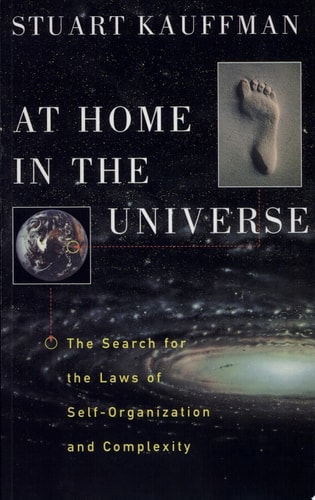
At Home in the Universe: The Search for the Laws of Self-Organization and Complexity
0
0
As an Amazon Associate and affiliate partner, Menrva Books earns from qualifying purchases. Learn more
Author Description
A major scientific revolution has begun, a new paradigm that rivals Darwin's theory in importance. At its heart is the discovery of the order that lies deep within the most complex of systems, from the origin of life, to the workings of giant corporations, to the rise and fall of great civilizations. And more than anyone else, this revolution is the work of one man, Stuart Kauffman, a MacArthur Fellow and visionary pioneer of the new science of complexity. Now, in At Home in the Universe, Kauffman brilliantly weaves together the excitement of intellectual discovery and a fertile mix of insights to give the general reader a fascinating look at this new science--and at the forces for order that lie at the edge of chaos.We all know of instances of spontaneous order in nature--an oil droplet in water forms a sphere, snowflakes have a six-fold symmetry. What we are only now discovering, Kauffman says, is that the range of spontaneous order is enormously greater than we had supposed. Indeed, self-organization is a great undiscovered principle of nature. But how does this spontaneous order arise? Kauffman contends that complexity itself triggers self-organization, or what he calls "order for free," that if enough different molecules pass a certain threshold of complexity, they begin to self-organize into a new entity--a living cell. Kauffman uses the analogy of a thousand buttons on a rug--join two buttons randomly with thread, then another two, and so on. At first, you have isolated pairs; later, small clusters; but suddenly at around the 500th repetition, a remarkable transformation occurs--much like the phase transition when water abruptly turns to ice--and the buttons link up in one giant network. Likewise, life may have originated when the mix of different molecules in the primordial soup passed a certain level of complexity and self-organized into living entities (if so, then life is not a highly improbable chance event, but almost inevitable).
Menrva's Summary
THE THESIS
This book investigates the fundamental question of whether the emergence of life and complex systems is a result of random chance or an inevitable consequence of self-organizing physical laws. Stuart Kauffman, a MacArthur Fellow and prominent researcher in the field of complexity, draws upon his extensive background in theoretical biology to argue that order arises spontaneously in complex systems. He posits that self-organization, or 'order for free,' acts as a primary driver alongside natural selection in the development of life and organizational structures.
THE SCOPE MAP
What You Will Find
- Theoretical frameworks regarding phase transitions in complex networks.
- The concept of 'order for free' as a mechanism for biological self-organization.
- Analogies illustrating how simple components reach thresholds to form integrated systems.
- Applications of complexity theory to fields ranging from molecular biology to corporate structures.
THE AUTHORITY PERSPECTIVE
Experts recognize this work as a foundational text for understanding the transition from classical evolutionary theory to the science of complexity. Readers frequently note the intellectual density of the prose, which balances rigorous scientific inquiry with accessible conceptual analogies for the general reader.
Page Count:
336
Publication Date:
1995-09-07
Publisher:
Oxford University Press
ISBN-10:
0195095995
ISBN-13:
9780195095999
Science
Physics
Order
Complexity Theory
Evolutionary Biology
Biology
Earth Sciences
Complexity Philosophy
Community Tags
Similar Books