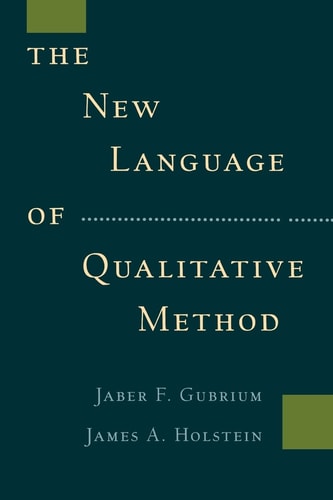
The New Language of Qualitative Method
0
0
As an Amazon Associate and affiliate partner, Menrva Books earns from qualifying purchases. Learn more
Author Description
In recent years scholars and researchers in all disciplines have moved away from traditional quantitative methods of research to more qualitative methods which emphasize questions of meaning and interpretation. Considering research methodologies as a set of idioms, The New Language of Qualitative Method examines alternate vocabularies for conveying social reality. It offers a new theoretical view which reintegrates the traditional emphasis on the whats of social life with a contemporary understanding of the hows and whys. The text considers the basic presumptions, objectives, and research questions of four major research traditions: naturalism, ethnomethodology, emotionalism, and postmodernism. Using illustrations from classic texts, it shows how each idiom supplies a unique perspective on empirical reality. The text then examines the risks and rewards of each approach, offering a vision of a renewed language of inquiry that accommodates both traditional and contemporary concerns. Striving for balance, the authors not only contend with issues from alternate perspectives, but provide a basis for rapprochement between research traditions that have often remained isolated from each other. They also demonstrate how each approach may be used for research on family, aging, deviance and social problems, and organizations and institutions. Written in an accessible and engaging style, The New Language of Qualitative Method can be adopted in courses across the social sciences, and may also be used by a broad spectrum of qualitative researchers.
Menrva's Summary
THE THESIS
This work investigates how researchers can reconcile traditional quantitative research objectives with contemporary qualitative methods by reframing methodologies as distinct linguistic idioms. Authors Jaber F. Gubrium and James A. Holstein, both established scholars in sociology, utilize this framework to bridge the gap between the 'whats' of social life and the 'hows' and 'whys' of human experience. By analyzing four major research traditions, they propose a renewed language of inquiry that encourages integration rather than isolation between competing academic schools of thought.
THE SCOPE MAP
What You Will Find
- Comparative analysis of four major research traditions: naturalism, ethnomethodology, emotionalism, and postmodernism.
- A theoretical framework for viewing research methodologies as sets of idioms or vocabularies.
- Practical applications of these methodologies within fields such as family studies, aging, deviance, and organizational analysis.
- Critical evaluation of the risks and rewards associated with different qualitative approaches.
THE AUTHORITY PERSPECTIVE
Experts and academics frequently cite this text as a foundational resource for understanding the evolution of qualitative inquiry across the social sciences. Readers often note that the authors successfully balance theoretical rigor with an accessible prose style, making it a standard reference for both graduate students and experienced researchers.
Page Count:
256
Publication Date:
1997-03-13
Publisher:
Oxford University Press
ISBN-10:
019509994X
ISBN-13:
9780195099942
Methodology
Social Research
Qualitative Research
Sociology
Research Methods
Social Science
Community Tags
Similar Books