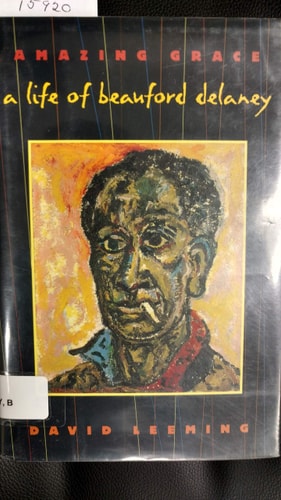
Amazing Grace: A Life of Beauford Delaney
0
0
As an Amazon Associate and affiliate partner, Menrva Books earns from qualifying purchases. Learn more
Author Description
Described by those who knew him best as a Buddha, a Merlin, and "a cross between Brer Rabbit and St. Francis of Assisi," the artist Beauford Delaney was anything but ordinary. James Baldwin, his closest friend, wrote that "He has been starving and working all of his life--in Tennessee, in Boston, in New York, and now in Paris. He has been menaced more than any other man I know by his social circumstances and also by all the emotional and psychological stratagems he has been forced to use to survive; and, more than any other man I know, he has transcended both the inner and the outer darkness." Indeed, these themes--grinding poverty, excruciating psychological torment, and the transcendence of inner and outer darkness through the light of his art--give shape and drama to Beauford Delaney's most extraordinary life.In Amazing Grace: A Biography of Beauford Delaney David Leeming, author of the acclaimed life of James Baldwin, tells the story of one of the most important black artists of our time with an affection, tact, and insight all too rare in recent biography. In chronicling Delaney's remarkable trajectory from a strong religious family in Knoxville to his death in an Parisian insane asylum, Leeming maintains a dual focus on Delaney's troubled inner life--his complicated homosexuality and the "voices" that would drive him mad--and his vibrant external life--his friendships with an amazing range of writers, artists, and musicians. Delaney seems to have known everyone, from Henry Miller, Jean Genet, Countee Cullen, and Elizabeth Bishop to Al Hirshfield, W.C. Handy, Alfred Steiglitz, Georgia O'Keeffe, Louis Armstrong, and virtually every other significant creative figure in New York and Paris. In many ways, Delaney's life focuses the major currents of twentieth century art. Leeming quotes generously from the journals, notebooks, letters, and critical reviews, tracing Delaney's movement away from representation--the street scenes and portraits of his "blues aesthetic"-
Menrva's Summary
THE THESIS
This biography investigates how Beauford Delaney navigated the intersection of extreme poverty, psychological instability, and racial identity to produce a significant body of modernist art. David Leeming, a biographer known for his work on James Baldwin, utilizes extensive primary source material—including personal journals, letters, and notebooks—to reconstruct Delaney's life. The narrative argues that Delaney’s artistic evolution from representational street scenes to abstraction was inextricably linked to his internal struggle with mental illness and his external experiences as a Black artist in the twentieth century. By examining these dual forces, Leeming provides a comprehensive framework for understanding Delaney's creative output and his enduring influence on the art world.
THE SCOPE MAP
What You Will Find
- A detailed account of Delaney's early life in Knoxville and his subsequent migration to Boston, New York, and Paris.
- An analysis of the artist's transition from the 'blues aesthetic' of his early portraits to his later abstract expressionist works.
- Primary source evidence drawn from Delaney's personal correspondence and journals, alongside critical reviews of his exhibitions.
- Documentation of Delaney's extensive social circle, including figures such as James Baldwin, Henry Miller, and Georgia O'Keeffe.
THE AUTHORITY PERSPECTIVE
Experts and critics frequently cite this work as a definitive account of Delaney's life, noting the author's balanced approach to the artist's complex psychological history. Readers often highlight the book's success in contextualizing Delaney's personal struggles within the broader movements of twentieth-century art and culture.
Page Count:
256
Publication Date:
1998-02-19
Publisher:
Oxford University Press
ISBN-10:
019509784X
ISBN-13:
9780195097849
Non-Fiction
Biography
United States
African Americans
Art History
Community Tags
Other Editions(2)

Similar Books









Reader Comments
Share Your Thoughts
No comments yet. Be the first to share your thoughts!