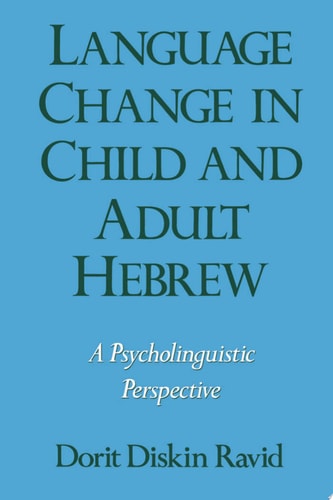
Language Change in Child and Adult Hebrew: A Psycholinguistic Perspective (Oxford Studies in Sociolinguistics)
0
0
As an Amazon Associate and affiliate partner, Menrva Books earns from qualifying purchases. Learn more
Author Description
The study of language acquisition has taken on new meaning in the last decade. Now seen as part of the study of other forms of language variation across time and space, such as dialects and sociolects, and the study of pidgins and Creoles, it can help to provide a new understanding of how language evolves and what directs its development. Dorit Ravid here provides a study of contemporary speakers of Hebrew, focusing in particular on inflectional morphology. She traces language development from childhood to adulthood in Hebrew speakers, and explores strategies of language acquisition and language processing leading to variation in the spoken Hebrew of speakers of different ages and socioeconomic backgrounds.
Menrva's Summary
THE THESIS
This book investigates the mechanisms of language development and variation in Hebrew speakers by examining the intersection of child language acquisition and adult linguistic processing. Dorit Diskin Ravid, a scholar in the field of psycholinguistics, utilizes a comparative framework to analyze how inflectional morphology evolves across the lifespan. By situating Hebrew within the broader context of language variation, the author argues that understanding acquisition is essential to grasping the evolutionary trajectory of language systems.
THE SCOPE MAP
What You Will Find
- Analysis of inflectional morphology in contemporary Hebrew speakers.
- Longitudinal comparison of linguistic strategies between children and adults.
- Examination of socioeconomic factors influencing spoken language variation.
- Psycholinguistic models of language processing and development.
THE AUTHORITY PERSPECTIVE
Experts recognize this work as a significant contribution to the study of Semitic languages and developmental psycholinguistics. Readers frequently note the academic density of the prose, which serves as a foundational text for researchers interested in the intersection of sociolinguistics and morphology.
Page Count:
256
Publication Date:
1995-08-17
Publisher:
Oxford University Press
ISBN-10:
0195090365
ISBN-13:
9780195090369
Linguistics
Psycholinguistics
Morphology
Hebrew Language
Community Tags
Similar Books