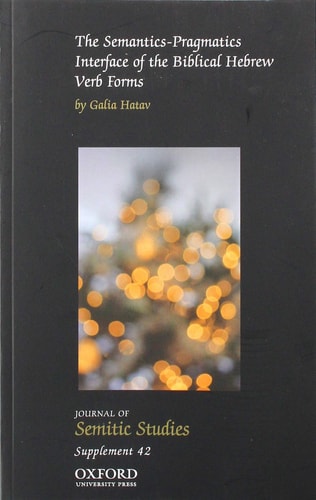
The Semantics-Pragmatics Interface of the Biblical Hebrew Verb Forms
0
0
As an Amazon Associate and affiliate partner, Menrva Books earns from qualifying purchases. Learn more
Author Description
This volume includes two general chapters; the first of these chapters suggests a new analysis of perfectivity in language, showing how the Biblical Hebrew verb forms encode perfectivity. The second deals with modality within the approach of possible-world-semantics, showing that Biblical Hebrew verb forms encode modality as well. The other six chapters concentrate on more specific issues that build on the general chapters: the way Biblical Hebrew anchors world and time, marks segmentation and discourse topic, represents speech and uses the volitives as opposed to the more general modals for performing speech acts.
Menrva's Summary
THE THESIS
This volume investigates the complex relationship between the semantic properties and pragmatic functions of Biblical Hebrew verb forms. Author Galia Hatav utilizes a framework of possible-world-semantics and discourse analysis to re-evaluate how these ancient verb forms encode perfectivity and modality. By bridging theoretical linguistics with classical philology, the work provides a systematic model for understanding how verb morphology anchors time and facilitates speech acts within the biblical text.
THE SCOPE MAP
What You Will Find
- A theoretical analysis of perfectivity as a linguistic category
- Application of possible-world-semantics to ancient Hebrew verb systems
- Examination of discourse-level features including segmentation and topic marking
- Comparative study of volitives versus general modal forms in speech act performance
THE AUTHORITY PERSPECTIVE
Scholars in the field of Semitic linguistics recognize this work as a rigorous application of modern semantic theory to classical texts. Readers frequently note the technical density of the prose, which is intended for an audience familiar with both linguistic methodology and Biblical Hebrew syntax.
Page Count:
272
Publication Date:
2018-01-01
Publisher:
OUP Oxford
ISBN-10:
0198840438
ISBN-13:
9780198840435
History
Semantics
Linguistics
Words Language & Grammar
Pragmatics
Reference
Hebrew Language
Community Tags
Similar Books