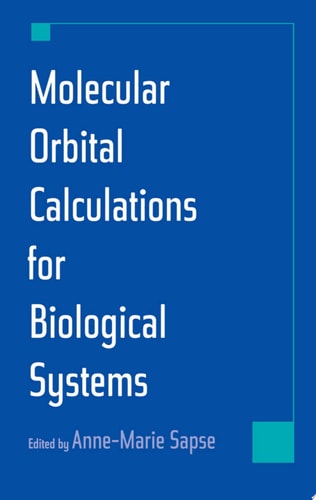
Molecular Orbital Calculations for Biological Systems
0
0
As an Amazon Associate and affiliate partner, Menrva Books earns from qualifying purchases. Learn more
Author Description
Molecular Orbital Calculations for Biological Systems is a hands-on guide to computational quantum chemistry and its applications in organic chemistry, biochemistry, and molecular biology. With improvements in software, molecular modeling techniques are now becoming widely available; they are increasingly used to complement experimental results, saving significant amounts of lab time. Common applications include pharmaceutical research and development; for example, ab initio and semi-empirical methods are playing important roles in peptide investigations and in drug design. The opening chapters provide an introduction for the non-quantum chemist to the basic quantum chemistry methods, ab initio, semi-empirical, and density functionals, as well as to one of the main families of computer programs, the Gaussian series. The second part then describes current research which applies quantum chemistry methods to such biological systems as amino acids, peptides, and anti-cancer drugs. Throughout the authors seek to encourage biochemists to discover aspects of their own research which might benefit from computational work. They also show that the methods are accessible to researchers from a wide range of mathematical backgrounds. Combining concise introductions with practical advice, this volume will be an invaluable tool for research on biological systems.
Menrva's Summary
THE THESIS
This volume investigates how computational quantum chemistry methods can be effectively integrated into biological research to complement experimental data and accelerate drug discovery. Anne-Marie Sapse, an expert in the field, provides a structured framework for non-quantum chemists to understand and apply complex modeling techniques. By bridging the gap between theoretical physics and practical biochemistry, the text argues that computational tools are accessible and necessary for modern molecular investigations.
THE SCOPE MAP
What You Will Find
- Fundamental introductions to ab initio, semi-empirical, and density functional theory methods.
- Practical guidance on utilizing the Gaussian series of computer programs for molecular modeling.
- Case studies applying quantum chemistry to amino acids, peptides, and anti-cancer drug development.
- Methodological advice for researchers with varying levels of mathematical expertise.
THE AUTHORITY PERSPECTIVE
Experts recognize this text as a practical bridge for biochemists seeking to incorporate computational modeling into their laboratory workflows. Readers frequently note the balance between accessible introductory theory and the specific, research-oriented applications provided in the latter chapters.
Page Count:
256
Publication Date:
1998-11-12
Publisher:
Oxford University Press
ISBN-10:
0195098730
ISBN-13:
9780195098730
Science
Peptides
Antineoplastic agents
Biomolecules
Chemistry
Biochemistry
Reference
Amino Acids
Computational Chemistry