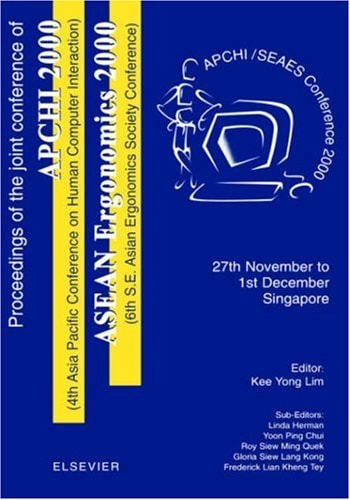
Proceedings of the 4th Asia Pacific Conference on Computer Human Interaction (APCHI 2000) and 6th S.E. Asian Ergonomics Society Conference (ASEAN Ergonomics 2000)
0
0
As an Amazon Associate and affiliate partner, Menrva Books earns from qualifying purchases. Learn more
Author Description
In the next millennium, it is anticipated that human factors issues will take centre stage in initiatives targeted at enhancing economic competitiveness and productivity. This development is already discernible in nascent knowledge and digital based industries and economies, which are expected to emerge in force in the near future and continue to dominate thereafter. These developments will establish irreversibly the emerging global economy. The theme of the APCHI 2000 conference is: "Towards a seamless integration of collaborative human computer systems" to reflect the already discernible shift in focus of human computer interaction (HCI). whilst the theme of the ASEAN Ergonomics 2000 conference is: "From user centeredness to people centeredness" to reflect the imminent shift in focus that is required of human factors. The papers in these proceedings provide a good contrast of human factors contributions to both old and new economies that make up ASEAN and APEC. They highlight the diverse roles human factors can play in advancing the quality of life in developed, developing and third world nations. They also serve as a guide to human factors practitioners in old economies on what to expect as their economies develop.
Menrva's Summary
THE THESIS
The proceedings explore the evolving role of human factors in the global economy, particularly in the context of emerging digital and knowledge-based industries. The book presents papers from the 4th Asia Pacific Conference on Computer Human Interaction (APCHI 2000) and the 6th S.E. Asian Ergonomics Society Conference (ASEAN Ergonomics 2000), addressing themes of seamless human-computer integration and the shift from user-centeredness to people-centeredness. The collected works highlight the diverse applications of human factors in both established and developing economies across ASEAN and APEC regions, offering insights into improving quality of life and guiding practitioners in traditional economies as they adapt to new economic landscapes.
THE SCOPE MAP
- Papers on the integration of collaborative human-computer systems.
- Discussions on the shift from user-centeredness to people-centeredness in human factors.
- Analysis of human factors contributions to both old and new economies.
- Exploration of the role of human factors in enhancing economic competitiveness and productivity.
- Insights into the quality of life in developed, developing, and third-world nations.
- Guidance for human factors practitioners in adapting to economic development.
THE AUTHORITY PERSPECTIVE
The collection addresses the anticipated centrality of human factors in future economic competitiveness and productivity, particularly within nascent digital and knowledge-based industries. The papers from APCHI 2000 and ASEAN Ergonomics 2000 offer a contrast between human factors' contributions to established and emerging economies within the ASEAN and APEC regions. The themes of seamless human-computer integration and the evolution towards people-centered design are central to the discussions. This compilation serves as a guide for practitioners, illustrating the broad impact of human factors on quality of life across diverse economic contexts.
Page Count:
524
Publication Date:
2000-11-30
Publisher:
Elsevier Science
ISBN-10:
0080438946
ISBN-13:
9780080438948
Non-Fiction
Science & Technology
Conference Proceedings
Ergonomics
Computer Science
Community Tags
Similar Books