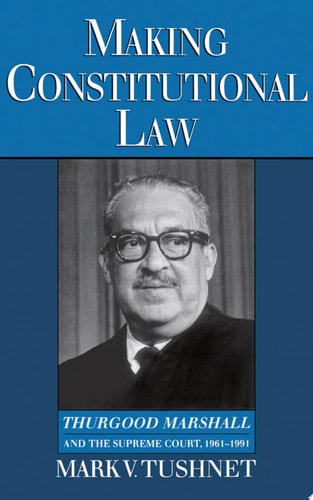
Making Constitutional Law: Thurgood Marshall and the Supreme Court, 1961-1991
0
0
As an Amazon Associate and affiliate partner, Menrva Books earns from qualifying purchases. Learn more
Author Description
Following on Making Civil Rights Law, which covered Thurgood Marshall's career from 1936-1961, this book focuses on Marshall's career on the Supreme Court from 1961-1991, where he was the first African-American Justice. Based on thorough research in the Supreme Court papers of Justice Marshall and others, this book describes Marshall's approach to constitutional law in areas ranging from civil rights and the death penalty to abortion and poverty. It locates the Supreme Court from 1967 to 1991 in a broader socio-political context, showing how the nation's drift toward conservatism affected the Court's debates and decisions.
Menrva's Summary
THE THESIS
This book investigates how Thurgood Marshall’s judicial philosophy and personal influence shaped American constitutional law during his tenure on the Supreme Court. Mark Tushnet, a legal scholar and expert on constitutional history, utilizes primary source materials from the Supreme Court archives to reconstruct Marshall’s decision-making process. The work examines how Marshall navigated the shifting political landscape of the United States between 1961 and 1991, specifically focusing on his role as the first African-American Justice. Tushnet argues that Marshall’s impact was defined by his consistent advocacy for civil rights and his resistance to the rising tide of judicial conservatism.
THE SCOPE MAP
What You Will Find
- Analysis of Marshall's judicial approach to civil rights, the death penalty, abortion, and poverty.
- Examination of the Supreme Court’s internal dynamics from 1967 to 1991.
- Primary source research derived from the personal papers of Justice Marshall and his contemporaries.
- Contextualization of judicial decisions within the broader socio-political shift toward conservatism in America.
THE AUTHORITY PERSPECTIVE
Legal scholars and historians frequently cite this work as a definitive account of Marshall’s judicial career. Readers often note the academic density of the prose, which provides a rigorous examination of the Court's internal operations during a transformative era in American law.
Page Count:
256
Publication Date:
1997-05-01
Publisher:
Oxford University Press
ISBN-10:
0195093143
ISBN-13:
9780195093148
Biography
History
United States
Supreme Court
Law