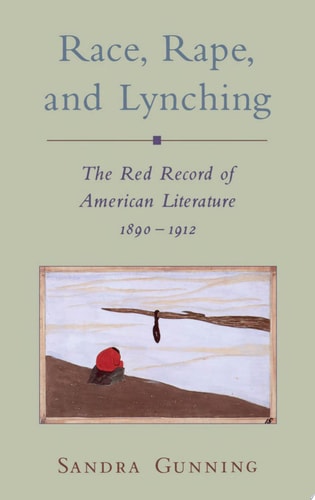
Race, Rape, and Lynching: The Red Record of American Literature, 1890-1912
0
0
As an Amazon Associate and affiliate partner, Menrva Books earns from qualifying purchases. Learn more
Author Description
In the late nineteenth century, the stereotype of the black male as sexual beast functioned for white supremacists as an externalized symbol of social chaos against which all whites would unite for the purpose of national renewal. The emergence of this stereotype in American culture and literature during and after Reconstruction was related to the growth of white-on-black violence, as white lynch mobs acted in "defense" of white womanhood, the white family, and white nationalism.In Writing a Red Record Sandra Gunning investigates American literary encounters with the conditions, processes, and consequences of such violence through the representation of not just the black rapist stereotype, but of other crucial stereotypes in mediating moments of white social crisis: "lascivious" black womanhood; avenging white masculinity; and passive white femininity. Gunning argues that these figures together signify the tangle of race and gender representation emerging from turn-of-the-century American literature. The book brings together Charles W. Chestnutt, Kate Chopin, Thomas Dixon, David Bryant Fulton, Pauline Hopkins, Mark Twain, and Ida B. Wells: famous, infamous, or long-neglected figures who produced novels, essays, stories, and pamphlets in the volatile period of the 1890s through the early 1900s, and who contributed to the continual renegotiation and redefinition of the terms and boundaries of a national dialogue on racial violence.
Menrva's Summary
THE THESIS
This work investigates how late nineteenth-century American literature utilized racial and gender stereotypes to mediate social crises and justify systemic violence. Sandra Gunning, a scholar of American literature and culture, examines the intersection of race, gender, and national identity during the post-Reconstruction era. By analyzing a diverse range of texts from the 1890s to 1912, she argues that literary representations of the 'black rapist' and other archetypes were instrumental in constructing white nationalist narratives and legitimizing the rise of lynching.
THE SCOPE MAP
What You Will Find
- Analysis of literary works by authors including Charles W. Chestnutt, Kate Chopin, Thomas Dixon, and Ida B. Wells.
- Examination of the 'black rapist' stereotype and its role in white supremacist ideology.
- Investigation of gendered archetypes such as 'lascivious' black womanhood and 'passive' white femininity.
- Exploration of the relationship between cultural production and the escalation of white-on-black violence in the American South.
THE AUTHORITY PERSPECTIVE
Scholars recognize this text as a significant contribution to the study of how literature reflects and reinforces racial hierarchies in post-Reconstruction America. Readers frequently note the academic rigor and the depth of the author's archival research into both canonical and neglected literary figures.
Page Count:
208
Publication Date:
1996-10-10
Publisher:
Oxford University Press
ISBN-10:
0195099907
ISBN-13:
9780195099904
History
Race Relations
Social Science
Gender Studies
In literature
American Studies
Literary Criticism