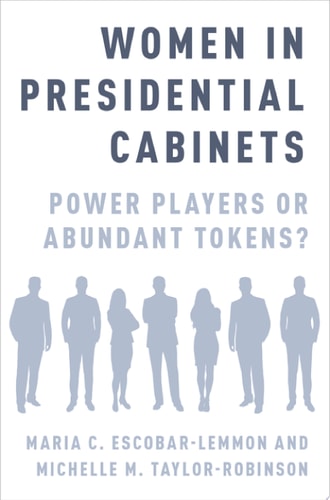
Women in Presidential Cabinets: Power Players or Abundant Tokens?
0
0
As an Amazon Associate and affiliate partner, Menrva Books earns from qualifying purchases. Learn more
Author Description
Though parity is still rare, presidential cabinets contain more women than ever before. Who are these women and what types of political capital resources do they bring to the administration? Are they new types of political players or very much like the men who have traditionally run the government? And once they gain office, are they treated equally in the cabinet? Do they have the capacity to be as effective as their male counterparts? Drawing on data from five presidential democracies -- Argentina, Chile, Colombia, Costa Rica, and the United States -- Women in Presidential Cabinets examines the backgrounds, connections and credentials of all full-rank cabinet ministers in presidential administrations over the course of two decades to determine if women and men bring similar numbers and diversity of political capital resources to the administration. Maria C. Escobar-Lemmon and Michelle M. Taylor-Robinson find that, with a few notable exceptions, presidents select men and women with similar work and education backgrounds, political experience, and linkages to related interest groups. There are, however, differences across types of posts and countries. They evaluate the treatment and effectiveness of similarly credentialed male and female ministers on four benchmarks. Specifically, they examine whether women with equal qualifications can really obtain all posts or whether glass ceilings persist in some areas. They then turn to the ability of women to hold onto a post, considering the nature and circumstances surrounding their departures from office and how long they remain in office. In doing so, they uncover evidence that female ministers in Latin America stand on an unequal playing field when it comes to the ability to enact policy through legislation. Ultimately, Escobar-Lemmon and Taylor-Robinson show conclusively that while women lack numerical equality, they are no longer tokens, instead appearing positioned to exercise power at the highest levels within the ex
Menrva's Summary
THE THESIS
This work investigates whether women appointed to presidential cabinets function as substantive political actors or merely as symbolic tokens within executive administrations. Authors Maria C. Escobar-Lemmon and Michelle M. Taylor-Robinson utilize a comparative political science framework to analyze the professional backgrounds, political capital, and career longevity of cabinet ministers. By contrasting the credentials of men and women across five presidential democracies, the authors argue that women are increasingly selected for their comparable qualifications rather than their gender alone, though systemic disparities in policy influence persist.
THE SCOPE MAP
What You Will Find
- Comparative analysis of cabinet appointments in Argentina, Chile, Colombia, Costa Rica, and the United States.
- Quantitative evaluation of professional credentials, including education, political experience, and interest group linkages.
- Benchmarks for ministerial effectiveness, including tenure duration and legislative success rates.
Scope Limits
- The study focuses exclusively on presidential systems and does not address parliamentary cabinet structures.
- The analysis is restricted to full-rank cabinet ministers and excludes lower-level executive appointees.
THE AUTHORITY PERSPECTIVE
Scholars in political science and gender studies identify this text as a rigorous empirical contribution to the study of executive branch diversity. Readers frequently note the academic density of the prose and the systematic nature of the comparative data provided.
Page Count:
319
Publication Date:
2016-01-01
Publisher:
Oxford University Press
ISBN-10:
019063216X
ISBN-13:
9780190632168
Gender Studies
Government
Sociology
American Studies
Public Policy
Community Tags
Similar Books



Reader Comments
Share Your Thoughts
No comments yet. Be the first to share your thoughts!