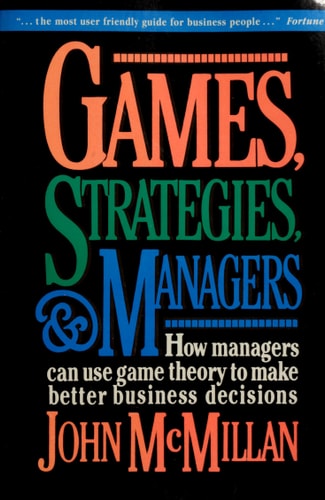
Games, Strategies, and Managers: How Managers Can Use Game Theory to Make Better Business Decisions
0
0
As an Amazon Associate and affiliate partner, Menrva Books earns from qualifying purchases. Learn more
Author Description
Business is a game--the greatest game in the world if you know how to play it," said IBM's founder Thomas J. Watson. He would probably agree that business negotiations are essentially the game of predicting what the other person will do. Faced with employees, subcontractors, salespeople and others, managers are continually called upon to make strategic decisions based on how someone else will act and react. How do the successful ones do it? Is it savvy? Guesswork? Even the most canny negotiators would be hard pressed to describe their own methods, which they generally develop intuitively over long and costly experience. But a key to becoming a top negotiator is now available to managers at all levels, in Games, Strategies, and Managers--the revealing new book that injects some science into the art of business decision-making.Adapted from the hottest new area of economic theory and based on the latest breakthroughs, Games, Strategies, and Managers goes far beyond the advice commonly offered to negotiators--the old saws, the tales about what worked once in Cleveland--to provide powerful insight into what's really going on beneath every negotiation. Using seven key questions as a starting point, it helps the executive strip away the distracting details of a situation. It doesn't matter if the issue is commissions, piece rates, royalties, managerial incentives, or cost-overrun provisions--the game is the same. The negotiator who recognizes these underlying rules and exploits them to best advantage will gain the upper hand, in formal negotiations as well as in dozens of everyday business situations. Of course, any game involves risk. Managers often have to make a decision without full knowledge of the consequences, and others' actions are not entirely predictable. Game theory explores how to take creative risks to get the strategic edge. Invaluable practical illustrations that show game theory in action include the setting of executives' incentives, the organizing of a
Menrva's Summary
THE THESIS
This book investigates how managers can utilize the principles of game theory to improve strategic decision-making and negotiation outcomes in complex business environments. John McMillan, an economist, translates complex mathematical models into practical frameworks for executives. He argues that business interactions are governed by predictable strategic rules, and by identifying these underlying structures, managers can move beyond intuition to make more calculated, effective choices.
THE SCOPE MAP
What You Will Find
- A framework of seven key questions to analyze any business negotiation or strategic situation.
- Methodologies for setting executive incentives and managing cost-overrun provisions.
- Analysis of risk management and decision-making under conditions of incomplete information.
- Practical illustrations of game theory applied to commissions, royalties, and piece rates.
THE AUTHORITY PERSPECTIVE
Experts recognize this work as a bridge between academic economic theory and practical managerial application. Readers frequently note that the prose remains accessible while providing a rigorous analytical structure for common business dilemmas.
Page Count:
264
Publication Date:
1996-05-02
Publisher:
Oxford University Press
ISBN-10:
0195108035
ISBN-13:
9780195108033
Economics
Business
Strategic Planning
Management
Game theory
Strategy
Decision Making
Community Tags
Similar Books