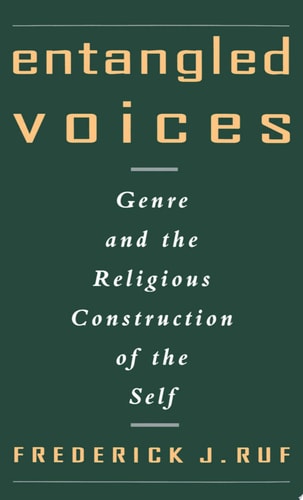
Entangled Voices: Genre and the Religious Construction of the Self
0
0
As an Amazon Associate and affiliate partner, Menrva Books earns from qualifying purchases. Learn more
Author Description
In this book, Ruf tries to understand how the concepts of "voice" and "genre" function in texts, especially religious texts. To this end, he joins literary theorists in the discussion about "narrative." Ruf rejects the idea of genre as a fixed historical form that serves as a template for readers and writers; instead, he suggests that we imagine different genres, whether narrative, lyric, or dramatic, as the expression of different voices. Each voice, he asserts, possesses different key qualities: embodiment, sociality, contextuality, and opacity in the dramatic voice; intimacy, limitation, urgency in lyric; and a "magisterial" quality of comprehensiveness and cohesiveness in narrative. These voices are models for our selves, composing an unruly and unstable multiplicity of selves. Ruf applies his theory of "voice" and "genre" to five texts: Dineson's Out of Africa, Donne's Holy Sonnets, Primo Levi's The Periodic Table, Robert Wilson's Einstein on the Beach, and Coleridge's Biographia Literaria. Through these literary works, he discerns the detailed ways in which a text constructs a voice and, in the process, a self. More importantly, Ruf demonstrates that this process is a religious one, fulfilling the function that religions traditionally assume: that of defining the self and its world.
Menrva's Summary
THE THESIS
This book investigates how the concepts of voice and genre function within religious and literary texts to construct the human self. Frederick J. Ruf, a scholar of religion, challenges the traditional view of genre as a static historical template. Instead, he proposes a framework where narrative, lyric, and dramatic genres act as distinct voices that shape the identity of the reader and writer. By analyzing specific literary works, Ruf argues that the act of constructing a self through these voices is inherently a religious process that defines both the individual and their world.
THE SCOPE MAP
What You Will Find
- A theoretical framework redefining genre as an expression of voice rather than a fixed historical form.
- Analysis of three primary voice categories: dramatic (embodiment, sociality, contextuality), lyric (intimacy, limitation, urgency), and narrative (comprehensiveness, cohesiveness).
- Case studies applying the theory to Dinesen's Out of Africa, Donne's Holy Sonnets, Levi's The Periodic Table, Wilson's Einstein on the Beach, and Coleridge's Biographia Literaria.
- An exploration of how literary construction mirrors the traditional religious function of defining the self.
THE AUTHORITY PERSPECTIVE
Scholars in the fields of religious studies and literary theory recognize this work as a significant contribution to the intersection of narrative identity and theological inquiry. Readers frequently note the dense, interdisciplinary nature of the prose, which bridges complex literary analysis with philosophical questions regarding the nature of the self.
Page Count:
136
Publication Date:
1997-01-02
Publisher:
Oxford University Press
ISBN-10:
0195102630
ISBN-13:
9780195102635
Religion
Philosophy
selfhood
Self
Narrative Theory
Literary Criticism
Community Tags
Similar Books