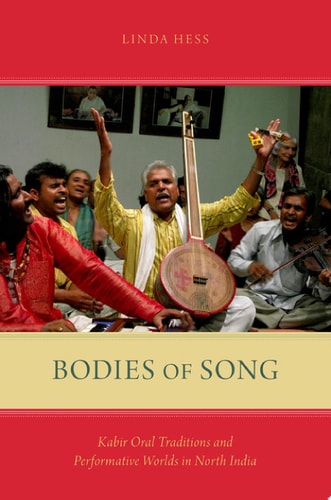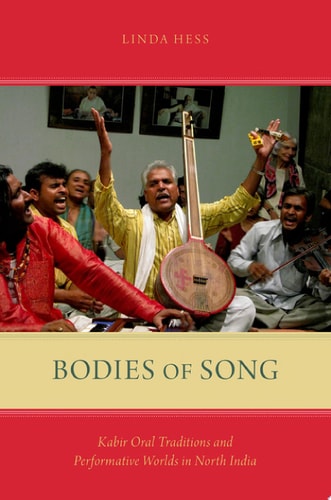
Bodies of Song: Kabir Oral Traditions and Performative Worlds in North India
0
0
As an Amazon Associate and affiliate partner, Menrva Books earns from qualifying purchases. Learn more
Author Description
Kabir was a great iconoclastic-mystic poet of fifteenth-century North India; his poems were composed orally, written down by others in manuscripts and books, and transmitted through song. Scholars and translators usually attend to written collections, but these present only a partial picture of the Kabir who has remained vibrantly alive through the centuries mostly in oral forms. Entering the worlds of singers and listeners in rural Madhya Pradesh, Bodies of Song combines ethnographic and textual study in exploring how oral transmission and performance shape the content and interpretation of vernacular poetry in North India. The book investigates textual scholars' study of oral-performative traditions in a milieu where texts move simultaneously via oral, written, audio/video-recorded, and electronic pathways.As texts and performances are always socially embedded, Linda Hess brings readers into the lives of those who sing, hear, celebrate, revere, and dispute about Kabir. Bodies of Song is rich in stories of individuals and families, villages and towns, religious and secular organizations, castes and communities. Dialogue between religious/spiritual Kabir and social/political Kabir is a continuous theme throughout the book: ambiguously located between Hindu and Muslim cultures, Kabir rejected religious identities, pretentions, and hypocrisies. But even while satirizing the religious, he composed stunning poetry of religious experience and psychological insight. A weaver by trade, Kabir also criticized caste and other inequalities and today serves as an icon for Dalits and all who strive to remove caste prejudice and oppression.
Menrva's Summary
THE THESIS
This book investigates how the oral transmission and performance of Kabir's poetry shape its content and contemporary interpretation within the social landscape of North India. Linda Hess, a scholar of Indian religious traditions, utilizes ethnographic fieldwork and textual analysis to examine the disconnect between academic focus on written manuscripts and the living, performative reality of Kabir's work. By observing singers and listeners in rural Madhya Pradesh, the author argues that Kabir's identity is continuously reconstructed through the intersection of oral, written, and electronic media.
THE SCOPE MAP
What You Will Find
- Ethnographic study of oral-performative traditions in rural Madhya Pradesh
- Analysis of the interplay between religious, social, and political interpretations of Kabir
- Examination of how caste, community, and identity influence the reception of vernacular poetry
Scope Limits
- The study does not provide a comprehensive biography of the historical Kabir
- The research does not cover the entirety of Kabir's written manuscript history
THE AUTHORITY PERSPECTIVE
Scholars recognize this work as a significant contribution to the study of oral traditions and the sociology of religion in South Asia. Experts highlight the book's success in bridging the gap between textual analysis and lived performance practice.
Page Count:
488
Publication Date:
2015-01-01
Publisher:
Oxford University Press
ISBN-10:
0190273178
ISBN-13:
9780190273170
History
Religion
Poetry
Musicology
Anthropology
Literary Criticism
English
English & College Success
India