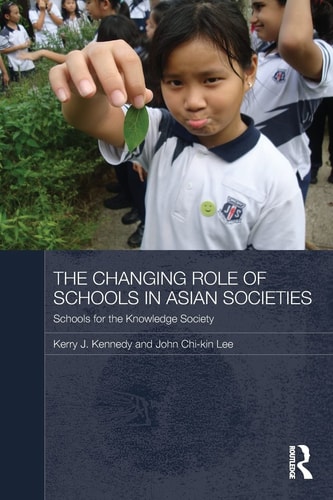
The Changing Role of Schools in Asian Societies: Schools for the Knowledge Society
0
0
As an Amazon Associate and affiliate partner, Menrva Books earns from qualifying purchases. Learn more
Author Description
Walk into a classroom in Tokyo, New York, London or Rotterdam, and the similarities in structure, activity, purpose and style will outweigh differences in language, dress and ethnic characteristics. Learning is regulated and rationed, teaching is a process or one-way transmission of knowledge, students need to be docile and conformist, assessment needs to sift and sort the bright from the not-so-bright, and rewards will be given to those who successfully negotiate this regime. But are these the kinds of places that can meet the needs of the ‘net generation’? The Changing Role of Schools in Asian Societiesis concerned with the debate about the nature of modern schooling in Asia. Traditionally schools are historical constructions reflecting the social, economic and political needs of the societies that invest in them. As Asia faces the challenges posed by the ‘knowledge economy’, its schools have taken on a new and quite different importance. This informative book outlines the broad policy contexts in which these transformations are taking place and the practical strategies that are needed to meet this objective. The authors argue that the future of Asian societies depends on a transformation that requires a fundamental restructuring of schools as we know them while maintaining their long-held cultural values. This valuable insight: provides an overview of educational issues in Asian societies establishes a broad theoretical framework in which these issues can be understood contextualizes issues by providing country case studies acknowledges the important role of culture influencing educational priorities. It should be of interest to all those working in education policy and comparative education.
Menrva's Summary
THE THESIS
The book investigates the evolving purpose and structure of educational institutions in Asian societies as they adapt to the demands of the 'knowledge economy'. The authors examine how traditional schooling models, characterized by regulated learning, knowledge transmission, and sorting mechanisms, are being challenged by the needs of the 'net generation'. The book argues that for Asian societies to thrive in the future, a fundamental restructuring of schools is necessary, one that balances the adoption of new educational strategies with the preservation of deeply held cultural values. It provides an overview of key educational issues across various Asian nations, establishing a theoretical framework for understanding these transformations and highlighting the influence of culture on educational priorities.
THE SCOPE MAP
- Overview of educational issues in contemporary Asian societies.
- Theoretical framework for understanding educational transformations.
- Analysis of the challenges posed by the 'knowledge economy' and the 'net generation' to traditional schooling.
- Exploration of practical strategies for restructuring schools.
- Discussion of the importance of maintaining cultural values within educational reform.
- Country case studies contextualizing educational issues in Asia.
- Examination of policy contexts influencing educational change.
THE AUTHORITY PERSPECTIVE
The book is positioned as a valuable resource for those involved in education policy and comparative education, offering an overview of educational issues in Asian societies and establishing a broad theoretical framework for understanding these transformations. It contextualizes these issues through country case studies and acknowledges the significant role of culture in shaping educational priorities. The authors' argument for a fundamental restructuring of schools, while preserving cultural values, addresses the critical need for Asian societies to adapt to the demands of the 'knowledge economy'. The work aims to provide insight into the broad policy contexts and practical strategies required for this significant educational evolution.
Page Count:
240
Publication Date:
2010-03-31
Publisher:
Routledge
ISBN-10:
0415586887
ISBN-13:
9780415586887
Politics
History
Non-Fiction
Asian Studies
Policy
Sociology
Education
Community Tags
Similar Books