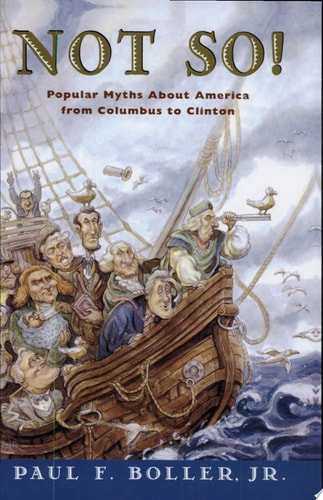
Not So!: Popular Myths About America From Columbus to Clinton
0
0
As an Amazon Associate and affiliate partner, Menrva Books earns from qualifying purchases. Learn more
Author Description
In sailing westward in 1492, did Columbus defy the prevailing belief that the Earth was flat? Was Thomas Paine an atheist? Was Truman plucked from obscurity to be FDR's running mate in 1944? Are presidential campaigns nowadays far dirtier than they were in the past? Is Hillary Clinton the most active or influential First Lady ever? Not so, says Paul Boller, in this delightfully informative look at some of the most common myths and misconceptions about the American past.As he did in his bestselling They Never Said It, Boller provides us with a cornucopia of historical correction, debunking myths that range from the trivial--for instance, George Washington did not have false teeth made of wood (they were made of ivory)--to the pernicious (FDR did not know in advance that the Japanese planned to bomb Pearl Harbor). We learn that most educated people in Columbus's day knew the world was round (it was Washington Irving who first portrayed Columbus as defying a coterie of flat-earthers); that Washington's famous Farewell Address was mostly written by Alexander Hamilton; that the Pledge of Allegiance was penned by Francis Bellamy, a devout socialist, in 1892 (and it was intended as a paean to big government); that Thomas Paine was not an atheist, but a deist (as were Washington, Jefferson, and Franklin), and his Age of Reason attacked both organized religion and atheism; that Truman was far from an obscure politician in 1944 (he had been on the cover of Time in 1943 for his Senate work uncovering waste and fraud in the war industries, and a Look magazine poll placed Truman among the ten figures who had contributed the most to the war effort); that presidential campaigns in the old days were more vituperative than recent ones; and that several First Ladies were more influential than Hillary Clinton, most notably Eleanor Roosevelt and Edith Wilson (the latter played a crucial role in her husband's administration from 1919 to 1921, after he suffered a massive stroke).
Menrva's Summary
THE THESIS
This book investigates the prevalence and persistence of historical misconceptions within the American narrative, questioning the factual accuracy of widely accepted anecdotes. Paul F. Boller Jr., a distinguished historian, utilizes primary source analysis and biographical records to systematically dismantle myths ranging from colonial-era legends to modern political folklore. By contrasting popular belief with documented evidence, the author provides a framework for critical historical inquiry and challenges the reader to re-examine the foundations of American cultural memory.
THE SCOPE MAP
What You Will Find
- Historical analysis of myths spanning from the era of Christopher Columbus to the Clinton administration.
- Evidence-based corrections regarding the personal lives and political actions of figures like George Washington, Thomas Paine, and Harry Truman.
- A methodology focused on debunking apocryphal stories through the examination of contemporary documents and historical context.
- Comparative studies of political campaigns and the influence of First Ladies across different centuries.
THE AUTHORITY PERSPECTIVE
Experts and readers alike recognize this work as a valuable resource for clarifying common historical inaccuracies that permeate public discourse. The text is noted for its accessible prose and its ability to synthesize complex historical data into a readable format for a general audience.
Page Count:
288
Publication Date:
1996-10-10
Publisher:
Oxford University Press
ISBN-10:
0195109724
ISBN-13:
9780195109726
History
Politics
Non-Fiction
Reference
United States
Mythology
American History
Community Tags
Similar Books














