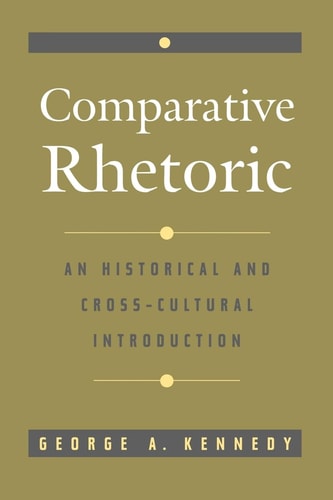
Comparative Rhetoric: An Historical and Cross-Cultural Introduction
0
0
As an Amazon Associate and affiliate partner, Menrva Books earns from qualifying purchases. Learn more
Author Description
Comparative Rhetoric is the first book to offer a cross-cultural overview of rhetoric as a universal feature of expression, composition, and communication. It begins with a theory of rhetoric as a form of mental and emotional energy which is transmitted from a speaker or writer to an audience or reader through a speech or text. In the first part of the book, George Kennedy explores analogies to human rhetoric in animal communication, possible rhetorical factors in the origin of human speech, and rhetorical conventions in traditionally oral societies in Australia, the South Pacific, Africa, and the Americas. Topics discussed include forms of reasoning, the function of metaphor, and the forms and uses of formal language. The second part of the book provides an account of rhetoric as understood and practiced in early literate societies in the Near East, China, India, Greece, and Rome, identifying unique or unusual features of Western discourse in comparison to uses elsewhere. The concluding chapter summarizes the results of the study and evaluates the validity of traditional Western rhetorical concepts in describing non-Western rhetoric.Addressing both what is general or common in all rhetorical traditions and what is unique or unusual in the Western tradition, Comparative Rhetoric is ideally suited for courses in rhetoric, rhetoric theory, the history of rhetoric, intercultural communication, linguistic anthropology, and comparative linguistics.
Menrva's Summary
THE THESIS
This book investigates whether rhetoric functions as a universal human phenomenon by examining its manifestations across diverse cultures and historical periods. George A. Kennedy, a prominent scholar in classical studies and rhetoric, utilizes a comparative framework to analyze how mental and emotional energy is transmitted through language. By contrasting Western rhetorical traditions with those of oral and early literate societies, he seeks to define the boundaries of rhetorical theory and its applicability beyond the Greco-Roman canon.
THE SCOPE MAP
What You Will Find
- Analysis of rhetorical analogies in animal communication and the origins of human speech.
- Examination of rhetorical conventions within oral societies in Africa, Australia, the South Pacific, and the Americas.
- Comparative study of early literate traditions in China, India, the Near East, Greece, and Rome.
- Evaluation of the validity of Western rhetorical concepts when applied to non-Western discourse.
THE AUTHORITY PERSPECTIVE
Scholars and students of communication theory frequently cite this work as a foundational text for understanding the cross-cultural dimensions of rhetoric. Experts note that the book provides a necessary critique of Western-centric academic models while offering a broad, accessible introduction to linguistic anthropology.
Page Count:
256
Publication Date:
1997-08-21
Publisher:
Oxford University Press
ISBN-10:
0195109333
ISBN-13:
9780195109337
History
Non-Fiction
Anthropology
Linguistics
Communication
Rhetoric
Community Tags
Similar Books














